AOMEI Partition Assistant
Can You Lock a Folder on Windows? Yes! 3 Secure Methods
Discover how to lock a folder on Windows 11. This guide answers 'can you password lock a folder on Windows' with step-by-step instructions for creating secure, locked folders to protect your privacy.

By Lucas / Updated on June 23, 2025


In an age of shared computers and growing concerns about digital privacy, you've likely asked the question: Can you lock a folder on Windows? You have sensitive work documents, private photos, or financial records that you don't want other users of your PC to access. While Windows doesn't offer a simple "right-click and lock" feature out of the box, the answer is a definitive yes. You absolutely can secure your folders. This guide will explore why you should, and then detail three distinct methods—from simple built-in tricks to robust third-party solutions—to help you protect your confidential data effectively.
Why Do You Need to Lock Folders on Windows?
Before we explore the 'how', let's quickly cover the 'why'. Understanding the need for folder security reinforces the importance of choosing the right method for your situation, whether it's for simple privacy or serious data protection.
Privacy on Shared Computers: In a family or office environment, multiple people might use the same computer. Locking a folder ensures that your personal files, correspondence, or Browse history remain private and inaccessible to other user accounts.
Protecting Sensitive Data: Many users store critical information on their laptops, including financial statements, business plans, client data, or personal identification documents. Wondering if you can password lock a folder on Windows is the first step to securing this information from unauthorized access.
Defense Against Data Breaches: If your laptop is ever lost or stolen, your Windows login password is the first line of defense. An encrypted, locked folder provides a crucial second layer of security. Even if a thief bypasses your login, your most important files will remain unreadable and secure. This is why knowing how to lock a folder on Windows 11 and other versions is a vital security skill.
3 Ways to Answer the Question: "Can You Lock a Folder on Windows?"
Let's get straight to the point. While Windows lacks a one-click password protection feature for folders, there are several effective methods to achieve the same result. Here are three proven ways to secure your data, ranging from basic to advanced.
Method 1: Use Windows Built-in Encryption (EFS)
This first method uses the Encrypting File System (EFS), a feature built directly into Windows Pro, Enterprise, and Education editions. It's a simple way to secure folders, but it works by tying the encryption to your user account, not by creating a separate password.
This means that as long as you are logged into your Windows account, you can access the folder freely. However, if another person logs into their account on the same PC, they will be unable to open your encrypted files.
Step 1. Right-click on the folder you wish to protect and select Properties. In the General tab, click the Advanced… button.
Step 2. In the "Advanced Attributes" window, check the box next to Encrypt contents to secure data.

Step 3. Click OK, and then click Apply in the Properties window.
Step 4. A confirmation dialog will appear. It’s highly recommended to select Apply changes to this folder, subfolders, and files to ensure everything within the folder is protected. Click OK.
The folder name may turn green, indicating it is encrypted. Windows will prompt you to back up your file encryption key. You must do this. If you lose access to your Windows account, this backup key is the only way to recover your data.
Method 2: Create a Locked Folder with a Batch Script
For those asking, can you create a locked folder on Windows with a unique password? This popular method uses a simple batch script. It's not a high-security solution, but it’s excellent for hiding folders from casual snoops without any extra software.
This script creates a private folder that can be hidden and "locked," requiring a password within the script to make it visible again. Be aware that a tech-savvy user can view the batch file's contents and find the password, so don't use this for highly sensitive data.
Step 1. Right-click on your desktop or inside any folder, and go to New > Text Document.
Step 2. Open the new text document and paste the following code exactly as it appears:
cls
@ECHO OFF
title Folder Private
if EXIST "Control Panel.{21EC2020-3AEA-1069-A2DD-08002B30309D}" goto UNLOCK
if NOT EXIST Private goto MDPRIVATE
:CONFIRM
echo Are you sure you want to lock the folder(Y/N)
set/p "cho=>"
if %cho%==Y goto LOCK
if %cho%==y goto LOCK
if %cho%==n goto END
if %cho%==N goto END
echo Invalid choice.
goto CONFIRM
:LOCK
ren Private "Control Panel.{21EC2020-3AEA-1069-A2DD-08002B30309D}"
attrib +h +s "Control Panel.{21EC2020-3AEA-1069-A2DD-08002B30309D}"
echo Folder locked
goto End
:UNLOCK
echo Enter password to unlock folder
set/p "pass=>"
if NOT %pass%==Your-Password-Here goto FAIL
attrib -h -s "Control Panel.{21EC2020-3AEA-1069-A2DD-08002B30309D}"
ren "Control Panel.{21EC2020-3AEA-1069-A2DD-08002B30309D}" Private
echo Folder Unlocked successfully
goto End
:FAIL
echo Invalid password
goto end
:MDPRIVATE
md Private
echo Private folder created successfully
goto End
:End
Step 3. Inside the script, find the line if NOT %pass%==Your-Password-Here goto FAIL and replace Your-Password-Here with the password you want to use.
Step 4. Go to File > Save As.... In the "Save as type" dropdown, select All Files. Name the file Locker.bat and save it.
Step 5. Double-click the Locker.bat file. This will create a new folder named Private.
Step 6. Move all your sensitive files and folders into the Private folder.
Step 7. Double-click Locker.bat again. It will ask if you want to lock the folder. Type Y and press Enter. The Private folder will disappear.
To unlock it, simply run Locker.bat again, enter the password you set, and the folder will reappear.
Method 3: Professional Security with BitLocker and AOMEI Partition Assistant
For the most robust security, the answer to "Can you password lock a folder on Windows?" lies in true encryption. We can achieve this by using BitLocker to encrypt hard disk, essentially creating a password-protected digital vault for your folders. AOMEI Partition Assistant Professional simplifies the management of this powerful feature.
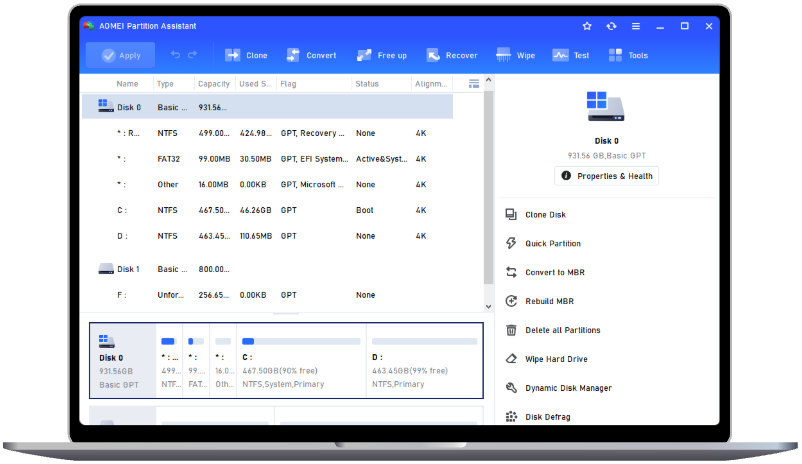
AOMEI Partition Assistant Professional is a comprehensive Windows disk management utility that makes complex tasks easy. Beyond resizing partitions or migrating your OS, it includes a dedicated BitLocker management tool. This tool provides a clean, user-friendly interface to enable, disable, and manage BitLocker encryption, making one of Windows' best security features accessible to everyone.
 100% Secure
Tip: If some of your PCs don't have the BitLocker feature, this tool can also allow your devices to perform BitLocker encryption.
Step 1. Launch AOMEI Partition Assistant Professional. Click the Tools tab in the top menu and select BitLocker.
Step 2. You will see a list of all drives. Find the drive you just created (e.g., Drive X:) and click the Turn On BitLocker option next to it.
Step 3. The encryption wizard will start. Check the box for "Use a password to unlock the drive". Enter a strong, memorable password in both fields.
Step 4. Next, you will be asked to back up your recovery key. This step is essential. Save it to a file or print it, and store it in a safe place separate from your computer.
Step 5. Click Next to begin the encryption process. Once finished, your virtual drive is fully encrypted.
Tip: How to Use Your Locked Folder:
Now, you can move your sensitive files into the new BitLocker drive (e.g., X:). To "lock" it, simply right-click the drive in File Explorer and select Eject. The drive will disappear. Windows will prompt you for the BitLocker password before mounting the drive.
Ending
So, can you lock a folder on Windows? Absolutely. While there isn't a single button for the job, you have multiple powerful options at your fingertips. We've covered the user-account protection of EFS, the quick and simple batch file trick for casual hiding, and the ultimate security solution of creating a password-protected virtual drive.
For users who need top-tier security and want to know how to lock a folder on Windows 11 with true encryption, combining a virtual disk with the easy management of BitLocker through AOMEI Partition Assistant provides an unbeatable and user-friendly solution. By choosing the method that best fits your security needs, you can confidently protect your private data from prying eyes.