AOMEI Partition Assistant
Solved: File Compression Is Only Available on Hard Disk Drives
Troubleshoot file compression problems in Windows. This article explains the role of NTFS and provides step-by-step instructions to fix "my pc can't compress the file," including a powerful third-party tool.

By Lucas / Updated on October 22, 2025


File compression is a handy built-in feature in Windows, allowing you to shrink the size of files and folders to save disk space and make them easier to share. However, it can be incredibly frustrating when you encounter an error message and find that "my PC can't compress the file." This common issue can stem from several factors, from the type of file system your drive uses to corrupted system files.
This article will demystify file compression on Windows, starting with a common misconception about its availability. More importantly, we will provide you with a clear, step-by-step guide on how to fix compression problems, using both Windows' native tools and a powerful third-party solution to get you back on track.
Why is file compression only Available on Hard Disk Drives?
There's a persistent myth that "file compression is only available on hard disk drives," which isn't entirely accurate. The ability to compress files and folders directly from the properties menu in Windows is not determined by whether you have an HDD or an SSD, but by the file system of the drive.
Windows' built-in compression feature, known as NTFS compression, is a feature of NTFS. This is the modern standard file system for Windows operating systems. If your drive is formatted with an older file system like FAT32 or exFAT, the "Compress contents to save disk space" option will be grayed out or unavailable. While you can still create zipped archives on any drive, the seamless, integrated compression is an NTFS-specific feature. So, the statement is a fiction; compression is a feature of the file system, not the physical drive type.
How Do I Fix "My PC Can't Compress the File"?
When you're faced with the inability to compress a file, there are several troubleshooting steps you can take. This section will guide you through the most effective solutions, from simple system checks to using advanced disk management software.
1. Check the Drive's File System
As mentioned, NTFS is required for the built-in compression feature. Here's how to check your drive's file system:
Step 1. Open File Explorer by pressing Windows key + E.
Step 2. Right-click the drive where the file is located (e.g., C: or D:) and select Properties.
Step 3. In the General tab, look for "File system." It should say NTFS.
If it says FAT32 or exFAT, you've likely found the source of your problem.
2. Run System File Checker (SFC)
Corrupted system files can interfere with many Windows functions, including file compression. The System File Checker tool can scan for and repair these files.
Step 1. Type "Command Prompt" in the Windows search bar.
Step 2. Right-click on Command Prompt and select Run as administrator.
Step 3. In the command prompt window, type sfc /scannow and press Enter.

Wait for the scan to complete. If it finds and repairs any issues, restart your computer and try compressing the file again.
3. Check for File Corruption
The issue might not be with your PC, but with the file itself. Some files, especially those that are already highly compressed (like JPG images, MP3 music, or MP4 videos) or encrypted, won't compress much further, if at all.[6] If you suspect the file is corrupted, try running a disk check.
Step 1. Open Command Prompt as an administrator.
Step 2. Type chkdsk X: /f (replace "X" with the letter of the drive the file is on) and press Enter.
This will check the drive for errors and attempt to fix them.
4. A Powerful Third-Party Solution: AOMEI Partition Assistant Professional
If the built-in solutions don't resolve your issue, or if your problem is a FAT32 file system, a dedicated disk management tool like AOMEI Partition Assistant Professional offers a robust and user-friendly alternative.
AOMEI Partition Assistant Professional is a comprehensive partition manager for Windows that simplifies complex disk operations. It allows users to resize, move, merge, and split partitions without data loss. Crucially for our problem, it can convert a drive from FAT32 to NTFS without needing to format it, thus preserving all your data while enabling Windows' compression feature.
 100% Secure
If you've discovered your drive is FAT32, here’s how to easily convert it to NTFS and fix the "can't compress file" issue using AOMEI Partition Assistant:
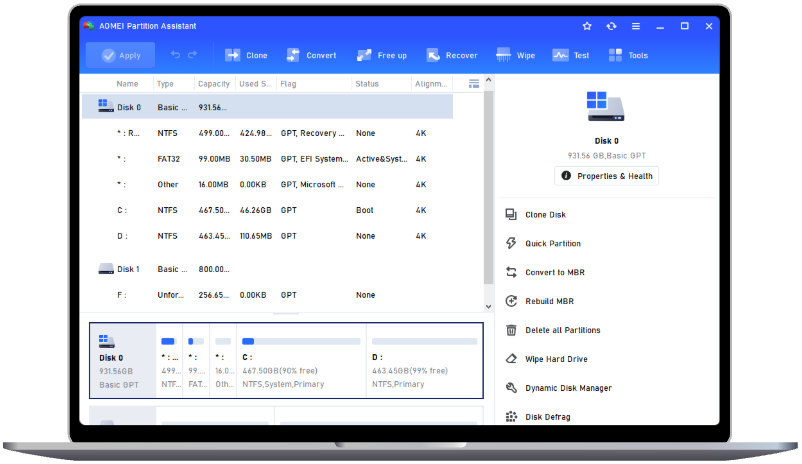
Step 1. Download and install AOMEI Partition Assistant Professional. Launch the software. In the main interface, you will see all your disks and their partitions.
Step 2. Select the partition. Click on "Convert" in the top toolbar and then select "Convert to NTFS/FAT32".
Step 3. Choose the conversion type. In the pop-up window, select "FAT32 to NTFS" and click "Next".
Confirm and proceed. You'll see a confirmation of the pending operation. Click "Proceed" and then "Yes" to begin the conversion process. The software will handle the rest, and your drive will be converted to NTFS without any data loss.
Once the conversion is complete, restart your PC. You should now be able to use the built-in file compression feature on that drive without any issues.
Other Useful Features of AOMEI Partition Assistant Professional
AOMEI Partition Assistant is more than just a file system converter. It's a full suite of tools to manage your hard drives effectively, including:
Partition Resizing/Moving: Easily extend your C: drive when it's running low on space.
OS Migration: Transfer your Windows installation to a new SSD or HDD without reinstalling.
Disk Cloning: Create an exact copy of your hard drive for backup or upgrade purposes.
App Mover: Move installed programs from one drive to another to free up space.
To Sum Up
Facing a "can't compress file" error can be a roadblock, but it's usually a solvable problem. The issue often boils down to your drive's file system rather than a fault in your hardware. While Windows provides basic tools to check for file system types and system errors, it may not offer a direct solution if your drive is formatted as FAT32.
By understanding the role of the NTFS file system, you can quickly diagnose the problem. For a straightforward and safe solution, especially when needing to convert a drive from FAT32 to NTFS without data loss, a reliable tool like AOMEI Partition Assistant Professional is invaluable. It not only solves the immediate compression issue but also provides a wealth of other disk management features to keep your PC running smoothly.