AOMEI Partition Assistant
A Beginner's Guide: How to Partition a 2nd Drive in Windows
Need to organize your new hard drive? This guide shows you how to partition a hard drive in Windows, create new volumes, and manage your disk space effectively with simple, safe methods.

By Lucas / Updated on October 24, 2025


Adding a second hard drive to your PC is an excellent way to expand your storage, but to make the most of that new space, you need to partition it. Partitioning a drive divides it into separate, manageable sections, or "volumes," each with its own drive letter. This process is essential for organizing your data, improving performance, and even running multiple operating systems. However, for many users, the question of how to partition a hard drive can seem daunting.
This guide will demystify the process for you. We will explain why partitioning is so beneficial and provide clear, step-by-step instructions on how to partition a 2nd drive in Windows. We'll cover both the standard built-in Windows tool and a more advanced, user-friendly third-party software to help you take full control of your storage.
Why Do You Need to Partition a Drive?
Before we dive into the "how," let's explore the "why." Taking a few minutes to partition a new drive offers several significant advantages that enhance how you use your computer.
Superior Organization: The most common reason is to separate your files. You can create one partition for games, another for important documents and photos, and a third for media files. This keeps your data tidy and prevents a single, massive drive from becoming a cluttered mess.
Easier Backups: By creating a dedicated partition for your most critical data, you can set up backup routines to image just that section. This is much faster and more efficient than backing up an entire drive every time.
-Dual-Booting Operating Systems: If you want to run another OS like Linux alongside Windows, it will require its own partition. Partitioning is the first step in setting up a multi-boot system.
Protecting Your Data: Separating your operating system (on the C: drive) from your personal data (on a second, partitioned drive) can safeguard your files. If your Windows installation becomes corrupted and needs to be reinstalled, your data on the other partitions will remain untouched.
How to Partition a 2nd Drive in Windows via System Tool
Now, let's get into the practical steps. We'll show you two effective methods to partition your new drive. Windows comes with its own tool, Disk Management, which is capable of handling basic partitioning tasks. This is a good starting point if your needs are simple.
Step 1. Open Disk Management: Press the Windows key + X and select "Disk Management" from the menu.
Step 2. Initialize the Disk: When you open Disk Management with a new drive installed, a pop-up will likely ask you to initialize it. You'll need to choose a partition style: GPT (GUID Partition Table) is modern and recommended for drives over 2TB, while MBR (Master Boot Record) is an older standard. Choose GPT and click "OK."

Step 3. Create a New Partition (Volume): Your new drive will now show as "Unallocated." Right-click on this unallocated space and select "New Simple Volume."
Step 4. Follow the Wizard: The New Simple Volume Wizard will open.
Step 5. Specify Volume Size: Decide how large you want this first partition to be. Enter the size in MB (1024 MB = 1 GB).
Step 6. Assign Drive Letter: Choose a drive letter from the dropdown menu (e.g., D:).
Step 7. Format Partition: Choose a file system (NTFS is the standard for Windows), leave the allocation unit size as "Default," and give the volume a name (like "Games" or "Data"). Check "Perform a quick format."
Step 8. Click "Next" and then "Finish." Your first partition is now ready. If you have remaining unallocated space, you can repeat the process to create more partitions.
While functional, Disk Management can be restrictive. For example, it's not very flexible when it comes to resizing or splitting existing partitions.
A Flexible & Powerful Tool: AOMEI Partition Assistant Professional
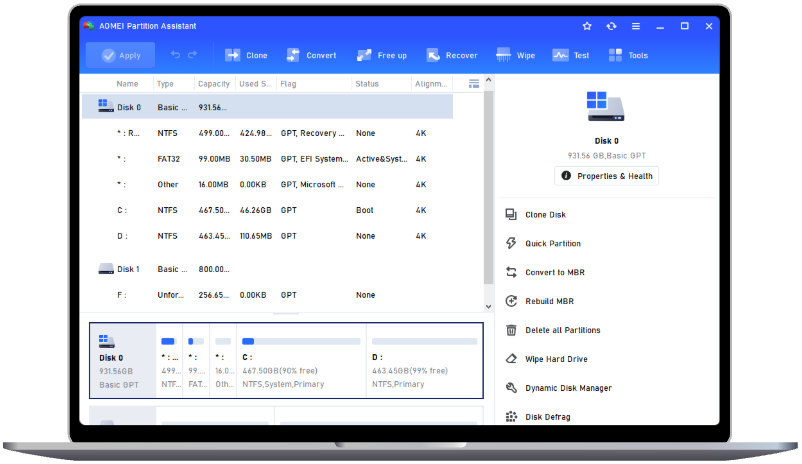
For a much more intuitive and powerful experience, a dedicated tool like AOMEI Partition Assistant Professional is the way to go. This comprehensive software simplifies all disk management tasks, from creating and resizing partitions to more complex operations, all within a user-friendly interface.
AOMEI Partition Assistant overcomes the limitations of the Windows tool, allowing you to easily split existing partitions or quickly set up a new drive with multiple partitions at once.
 100% Secure
How to Split an Existing Partition to Create a New One
Perhaps you already set up your second drive as one large volume, but now want to divide it. AOMEI Partition Assistant makes this easy without losing data.
Step 1. Download and install AOMEI Partition Assistant Professional. Launch the software. Right-click the large partition on your second drive that you want to split and select "Split Partition."
Step 2. Define the New Size: In the pop-up window, use the slider to specify the size for the new partition you are creating from the existing one. Click "OK."
Step 3. Apply the Operation: You'll see a preview of the change. To execute it, click "Apply" in the top-left corner and then "Proceed."
How to Partition a Hard Drive in One Go (Quick Partition)
For a brand new drive, the "Quick Partition" feature is incredibly efficient. It allows you to create multiple partitions with your desired sizes and settings in a single operation.
Step 1. Install your new drive and launch AOMEI Partition Assistant. Right-click the new disk (marked as unallocated) and select "Quick Partition."
Step 2. In the pop-up window, you can select from a list of common partition layouts or customize it by choosing the number of partitions you want.
Step 3. You can adjust the size, file system, and labels for each partition on the fly.
Step 4. Once you've configured it to your liking, click "Start Partitioning." The software will create and format all the partitions automatically.
Beyond this, AOMEI Partition Assistant also excels at other tasks. If you need to know how to delete disk partitions, you can do so easily and securely, with an option to wipe the data permanently so it cannot be recovered.
To Sum Up
Partitioning a second hard drive is a fundamental step in effective data management. It helps you stay organized, simplifies backups, and can even protect your data in the event of a system failure. While the built-in Windows Disk Management can handle basic tasks, it often lacks the flexibility required for more complex scenarios.
For a truly seamless and powerful experience, AOMEI Partition Assistant Professional is the superior choice. Whether you need to split an existing partition, quickly partition a new drive, or perform any other disk management task, its intuitive interface and robust feature set make the process simple and safe for users of all skill levels. By taking a few moments to properly partition your drive, you set yourself up for a more organized and efficient computing experience.