AOMEI Partition Assistant
Secure Your Data: A Comprehensive Guide to Windows File Encryption
Protect your sensitive information with our expert guide on Windows file encryption. We cover everything from the Encrypting File System (EFS) to using third-party tools for complete data security. Find out how to encrypt your files and why it's crucial for your digital safety.

By Lucas / Updated on June 23, 2025


In an age where digital information is paramount, safeguarding your sensitive files from unauthorized access is more critical than ever. Whether it's personal financial records, confidential business documents, or private photos, implementing robust security measures on your Windows computer is essential. This is where Windows file encryption comes into play, offering a powerful method to protect your data. This article will serve as your comprehensive guide, exploring why you need to encrypt your files, how to perform encryption on Windows, and introducing powerful tools to simplify the process.
Why Do You Need to Perform Windows File Encryption?
Understanding the importance of encrypting your files is the first step toward better data security.
In today's digital landscape, the need for robust data security is paramount. From personal memories to critical business intelligence, our computers house a vast amount of sensitive information. Windows file encryption serves as a crucial line of defense, rendering your data unreadable and inaccessible to anyone without the proper authorization. This is particularly vital in scenarios of device theft or loss, as it ensures your private information remains confidential.
Beyond safeguarding against physical threats, encryption is a cornerstone of protecting your privacy from online threats. Cybercriminals continually develop new methods to breach systems and steal valuable data. By encrypting your files, you create a significant barrier, making it exceedingly difficult for malicious actors to profit from your information, even if they manage to infiltrate your system. Furthermore, for professionals and businesses, encrypting files is often a matter of regulatory compliance, with standards like GDPR and HIPAA mandating stringent data protection measures.
How to Encrypt a File on Windows
When it comes to securing your data, knowing how to encrypt a file on Windows is a practical skill every user should possess. Fortunately, Windows offers built-in tools, and third-party software can provide even more comprehensive solutions. This section will guide you through various methods for implementing Windows file encryption.
Method 1: Using the Encrypting File System (EFS) in Windows
For users of Windows Pro, Enterprise, or Education editions, the Encrypting File System (EFS) is a readily available feature that allows for the encryption of individual files and folders. This system is tied to your user account, meaning that once you've encrypted a file, only you can access it when logged into your account.
Step 1. Locate the File or Folder: Right-click on the file or folder you wish to encrypt and select "Properties" from the context menu.
Step 2. Access Advanced Attributes: In the "General" tab, click on the "Advanced..." button.
Step 3. Enable Encryption: In the "Advanced Attributes" window, check the box next to "Encrypt contents to secure data."

Step 4. Confirm Changes: Click "OK" to close the "Advanced Attributes" window, and then click "Apply" in the "Properties" window.
Step 5. Choose Encryption Scope: A confirmation dialog will appear. It's generally recommended to select "Encrypt the file and its parent folder" for enhanced security.
Step 6. Backup Your Encryption Key: You will be prompted to back up your file encryption key. This is a critical step. If you lose access to your user account, this backup is the only way to recover your encrypted files.
Method 2: A Comprehensive Solution with AOMEI Partition Assistant Professional
While EFS is a useful tool, for those seeking a more robust and user-friendly approach to data protection that extends to entire drives, a third-party tool is often the best solution. For comprehensive Windows file encryption, we recommend AOMEI Partition Assistant Professional. This powerful Windows computer management software simplifies disk and partition management and offers a seamless way to manage BitLocker encryption.
It's an all-in-one disk management utility that empowers users to optimize their hard drive usage and enhance data security. One of its standout features is the ability to easily manage BitLocker Drive Encryption. While BitLocker encrypts an entire volume, this approach ensures that every file and folder within that drive is protected, providing a comprehensive security blanket for your data. AOMEI Partition Assistant Professional makes the often-complex process of managing BitLocker straightforward, even for users who are not tech-savvy.
 100% Secure
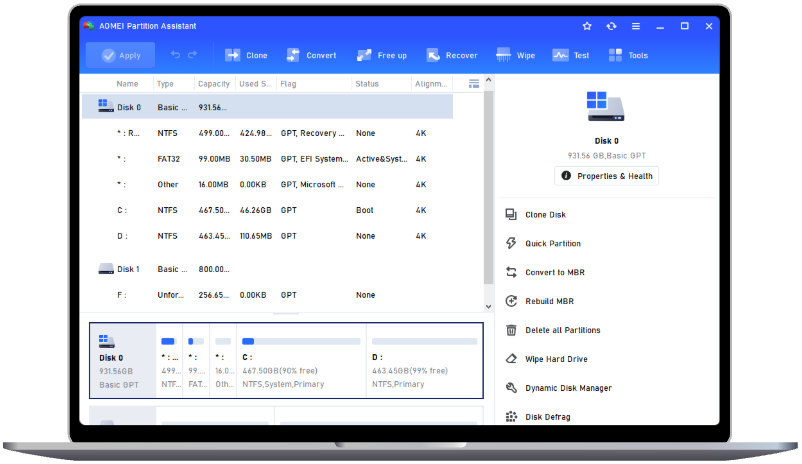
Step 1. Install and Launch: Download and install AOMEI Partition Assistant Professional. Launch the software to view its main interface.
Step 2. Access the BitLocker Tool: In the main console, click on "Tools" in the top menu and select "BitLocker."
Step 3. Select the Drive: A list of all your drives will be displayed. Choose the drive you want to encrypt and click on the "Turn on BitLocker" option.
Step 4. Set Your Password: You will be prompted to create and confirm a strong password for your encrypted drive. This password will be required to unlock the drive.
Step 5. Back Up Your Recovery Key: Similar to EFS, you will be given options to back up your recovery key. This is crucial for regaining access to your data if you forget your password. You can save it to a file or print it.
Step 6. Start Encryption: Once you have securely backed up your recovery key, the encryption process will begin. The time it takes will depend on the size of the drive.
By using AOMEI Partition Assistant Professional, you not only achieve a high level of Windows file encryption but also benefit from a suite of other disk management tools that can improve your computer's performance and organization.
Ending
In conclusion, Windows file encryption is an indispensable practice for anyone looking to secure their digital life. From protecting your personal information from prying eyes to complying with industry regulations, the benefits are clear. We've explored the native Encrypting File System in Windows and provided a step-by-step guide on how to encrypt a file on Windows.
For those seeking a more comprehensive and user-friendly solution, AOMEI Partition Assistant Professional offers a powerful way to manage BitLocker and ensure all your files are protected through full-drive encryption. By taking proactive steps to encrypt your data, you can have peace of mind knowing your sensitive information is safe and secure.