
 PartitionAssistant Recovery


Windows 10 Can't View Hidden Items? Here's How to Fix It!
Experiencing windows 10 can't view hidden items? Discover multiple ways to make windows view hidden files again. Plus, get expert tips on how to retrieve hidden files that are lost or deleted with AOMEI Partition Assistant for Recovery.

By Lucas / Updated on August 8, 2025


It's a common scenario: you know a file or folder exists on your Windows 10 PC, but you just can't view hidden items. This can be incredibly frustrating, especially when you need to access system files, application data, or personal documents that have somehow become hidden.
Windows hides certain files and folders by default to protect critical system operations from accidental modification, but sometimes users need to reveal them. When you find that Windows 10 can't view hidden items, it could be due to incorrect settings, system corruption, or even a malicious program.
This comprehensive guide will walk you through various methods to reveal these elusive files and provide solutions if the standard approaches fail, ensuring you understand how do I view hidden files in Windows 10.
How to Fix Windows 10 Can't View Hidden Items
If you're struggling because Windows 10 can't view hidden items, don't worry. There are several straightforward methods to reveal hidden files and folders, ranging from simple File Explorer adjustments to more advanced system checks.
Method 1. Use Alternative Ways to Show Hidden Files
Windows offers multiple ways to toggle the visibility of hidden files. If one method doesn't seem to work, trying an alternative can often resolve the issue and help you understand how do I view hidden files in Windows 10.
Option 1. View to show hidden items
Step 1. Open File Explorer by clicking its icon on the taskbar or pressing Windows key + E.
Step 2. Navigate to the folder where you suspect the hidden files are located.
Step 3. In the File Explorer ribbon at the top, click on the "View" tab.

Step 4. In the "Show/hide" group, check the box next to "Hidden items".
You should now see hidden files and folders, which will often appear slightly transparent or "ghosted" to distinguish them from regular files.
Option 2. Try Control Panel
Step 1. Type "Control Panel" in the Windows search bar and open it.
Step 2. In the Control Panel, change "View by" to "Large icons" or "Small icons" for easier navigation, then click on "File Explorer Options" (formerly Folder Options).
Step 3. In the "File Explorer Options" window, go to the "View" tab.
Step 4. Under "Advanced settings," scroll down and locate "Hidden files and folders."
Step 5. Select the option "Show hidden files, folders, and drives."
Step 6. (Optional but often necessary for system files): Uncheck "Hide protected operating system files (Recommended)." You'll see a warning; click "Yes" to proceed.
Step 7. Click "Apply" and then "OK". All hidden files and folders, including system files, if you unchecked the option, should now be visible across your system.
Option 3. Show Hidden Files Using CMD
For users comfortable with the command line, the attrib command offers a powerful way to manage file attributes, including the hidden attribute. This is particularly useful if graphical methods are failing, as Windows 10 can't view hidden items.
Step 1. Type "cmd" in the Windows search bar, right-click on "Command Prompt," and select "Run as administrator."
Step 2. To view all files, including hidden ones, in the current directory, type:
dir /a:h
and press Enter. This will list only hidden files and folders.
Step 3. To show all hidden files and folders within a specific directory and its subdirectories, you can use the attrib command. For example, to unhide all hidden files and folders on your D: drive, type:
attrib -h -s -r /s /d D:\*.*
and press Enter.
-h: Removes the hidden attribute.
-s: Removes the system attribute.
-r: Removes the read-only attribute (optional, but often paired with hidden issues).
/s: Processes matching files in the current folder and all subfolders.
/d: Includes directories (folders) in the processing.
D:\*.*: Specifies the target drive (replace D with the actual drive letter) and all files/folders.
Method 2. Run System File Checker Tool
Corrupted system files can sometimes interfere with how Windows functions, including the ability to show hidden items. The System File Checker (SFC) tool can scan for and repair such corruptions, which might resolve the issue of Windows 10 can't view hidden items.
Step 1. Type "cmd" in the Windows search bar, right-click on "Command Prompt," and select "Run as administrator."
Step 2. In the Command Prompt window, type:
sfc /scannow
and press Enter.
Step 3. The scan will begin and may take some time. Do not close the window until the verification is 100% complete.
If SFC finds corrupted files, it will attempt to repair them. After the scan, restart your computer and try to show hidden files again using one of the methods in Method 1.
Method 3. Adjust the Registry
Advanced users can directly modify the Windows Registry to control the visibility of hidden files. This method should be used with caution, as incorrect changes to the Registry can cause system instability. Always back up your Registry before making changes. This is a powerful way to troubleshoot when Windows view hidden files options aren't working.
Step 1. Press Windows key + R to open the Run dialog. Type regedit and press Enter to open the Registry Editor. Navigate to the following path: HKEY_CURRENT_USER\Software\Microsoft\Windows\CurrentVersion\Explorer\Advanced
Step 2. In the right-hand pane, look for the DWORD (32-bit) Value named "Hidden".
Step 3. Double-click "Hidden."
To show hidden files, folders, and drives, set its "Value data" to 1.
To hide hidden files, folders, and drives, set its "Value data" to 2.
Step 4. Next, look for the DWORD (32-bit) Value named "ShowSuperHidden". Double-click "ShowSuperHidden."
To show protected operating system files, set its "Value data" to 1.
To hide protected operating system files, set its "Value data" to 0.
Step 5. Close Registry Editor. The changes should take effect immediately. If not, restart File Explorer or your computer.
Method 4. Retrieve Hidden Files
Even after trying the above methods, you might still encounter situations where certain files remain elusive, or perhaps you suspect files were accidentally hidden or even deleted by malware. In such cases, you might need to retrieve hidden files using a dedicated data recovery tool.
PartitionAssistant Recovery is a comprehensive disk management software renowned for its powerful features, including robust data recovery capabilities. While primarily known for partitioning and disk optimization, this tool is an excellent solution for finding all types of unseen files, whether they are intentionally hidden, accidentally deleted, or lost due to file system corruption or virus attacks.
It's an indispensable tool for users who can't view hidden files in Windows 10 through conventional means, or those who suspect deeper data integrity issues. Its intuitive interface guides users through the recovery process, making it accessible even for those without extensive technical knowledge, helping you truly how to retrieve hidden files.
Step 1. Install and launch PartitionAssistant Recovery. Choose the exact partition or disk where your data lost and click Scan.

Step 2. Then, the recovery tool start to scan and search. lt will execute the “Quickly Scan" first for finding your deleted data fast, and then execute the “Deep Scan" for searching other lost data.

Step 3. Once the scan is completed, all deleted files, recycle bins and other missing files will be displayed. Please select the file you would like to recover and then click "Recover".

Step 4. Then, select a folder path to save your recovered files.
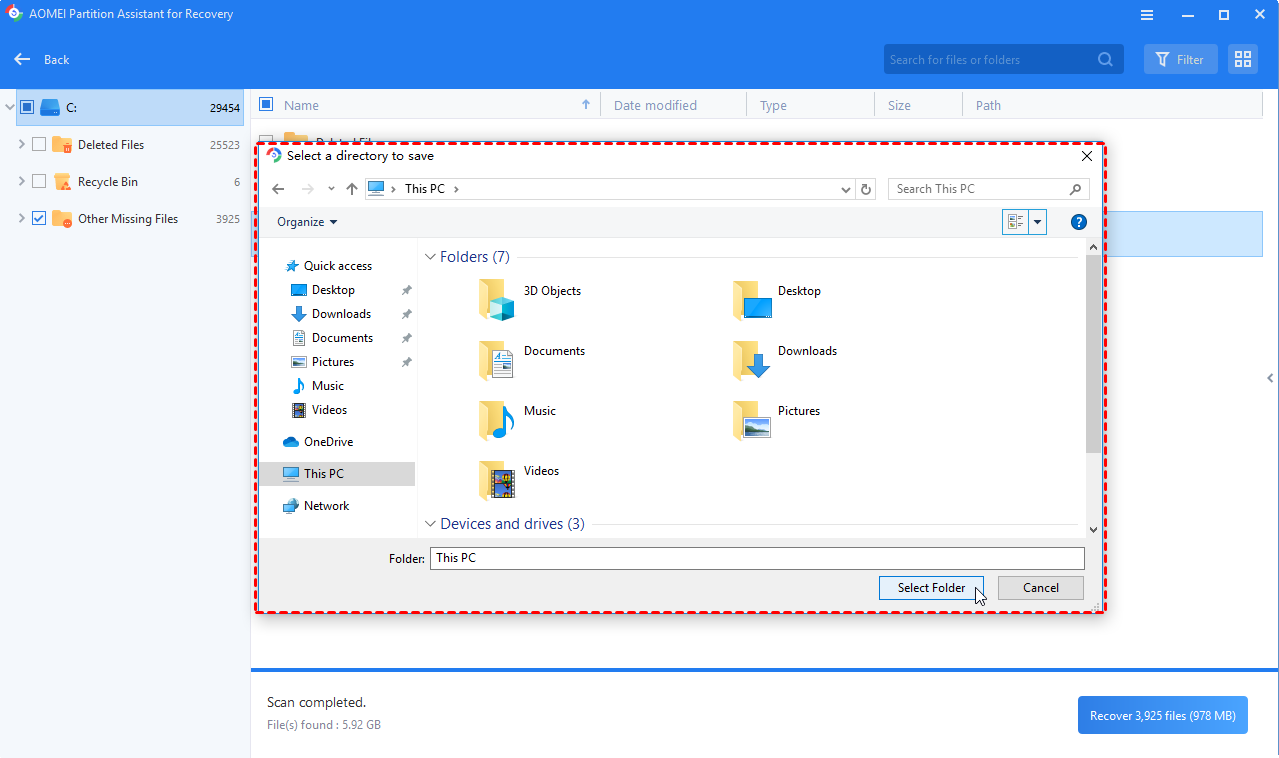
Step 5. Wait patiently for this process of recovery to end.
Ending
When Windows 10 can't view hidden items, it can be a source of significant frustration, obscuring important data or system files. Fortunately, Windows provides several built-in methods, from simple File Explorer tweaks to command-line operations and Registry adjustments, to make these files visible.
For more persistent issues, or when you need to know how to retrieve hidden files that might be truly lost or corrupted, professional tools like PartitionAssistant Recovery stand ready to help.
By understanding and applying these solutions, you can effectively manage your files, ensure data accessibility, and maintain control over your Windows 10 system, transforming the challenge of viewing hidden files into a solvable problem.
