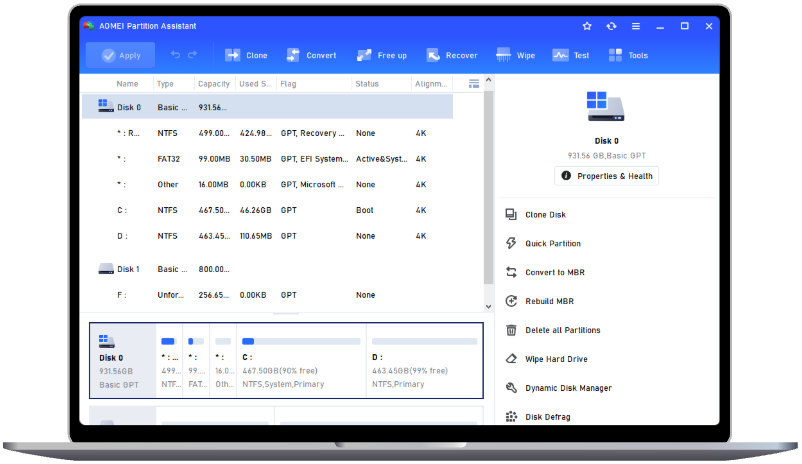
AOMEI Partition Assistant
Unveiling the Dynamics of an Active Partition
Delve into the world of active partitions and unravel their significance in managing storage and system configurations. Explore the essential concepts and practical insights to harness the potential of active partitions for enhanced system performance and organization.

By Hedy / Updated on January 29, 2024


An active partition, in the realm of computer science, holds significant importance in managing the storage and retrieval of data on a computer system. Understanding the intricacies of an active partition is crucial for optimizing system performance and ensuring seamless operation. In this comprehensive guide, we delve into the dynamics of an active partition, exploring its functions, common issues, troubleshooting methods, and best practices for efficient management.
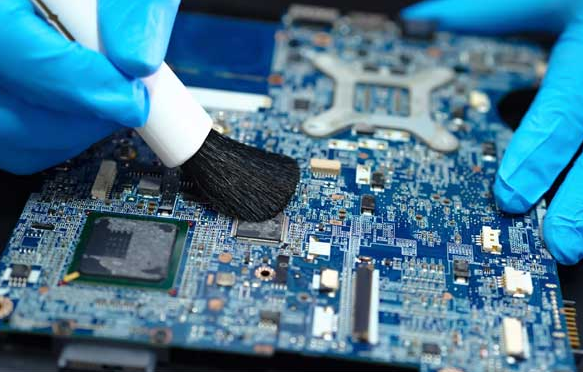
Overview of an Active Partition
An active partition serves as a designated area on a storage device, typically a hard disk drive or solid-state drive, that contains essential system files required for booting the operating system. It is marked as active to indicate to the system BIOS or UEFI firmware that it contains the necessary files to initiate the boot process. Without an active partition, the system would be unable to start up properly.
An active partition plays a pivotal role in the boot process, facilitating the loading of critical system files and initiating the operating system's startup sequence. It contains the boot loader, boot manager, and other essential components necessary for launching the operating system.
Causes of Active Partition Issues
Several factors can contribute to issues related to an active partition:
1. **Incorrect Boot Configuration**:
Improper configuration of the boot settings or bootloader installation can result in an inactive or improperly designated active partition.
2. **Disk Corruption**:
File system errors, disk corruption, or bad sectors on the storage device can render the active partition inaccessible or non-functional.
3. **Bootloader Errors**:
Errors within the bootloader, such as missing or corrupted boot files, can prevent the system from recognizing the active partition and initiating the boot process.
Understanding these potential causes is essential for diagnosing and resolving active partition issues effectively.
Solutions for Active Partition Problems
To address issues with an active partition, consider the following solutions:
1. Verify Boot Configuration**:
Access the system BIOS or UEFI settings to ensure that the correct partition is designated as active for booting.
2. **Repair Disk Errors**:
Use built-in disk repair utilities or third-party disk management tools to scan and repair any file system errors or disk corruption affecting the active partition.
3. **Rebuild Bootloader**:
Reinstall or repair the bootloader to restore missing or corrupted boot files and resolve issues preventing the system from recognizing the active partition.
By implementing these solutions, you can troubleshoot and resolve common issues affecting the functionality of an active partition.
Frequently Asked Questions (FAQs) about Active Partitions
Q1: What is the purpose of an active partition?
A: An active partition contains essential system files required for booting the operating system and initiating the startup process.
Q2: How do I designate an active partition?
A: You can designate an active partition using disk management utilities or system BIOS/UEFI settings.
Q3: Can I have multiple active partitions on a single disk?
A: No, a disk can have only one active partition at a time.
Q4: What happens if the active partition is corrupted?
A: A corrupted active partition can prevent the system from booting properly, requiring repair or restoration of essential boot files.
Q5: Is it possible to change the active partition without reinstalling the operating system?
A: Yes, you can change the active partition using disk management tools without reinstalling the operating system.
These FAQs provide valuable insights into common queries related to active partitions and their management.
Key Terms Related to Active Partitions
1. **Bootloader**: A program that loads the operating system into memory during the boot process.
2. **File System**: The method used by an operating system to organize and store data on a storage device.
3. **BIOS**: Basic Input/Output System, a firmware interface used to initialize hardware components during the boot process.
4. **UEFI**: Unified Extensible Firmware Interface, a modern replacement for BIOS that provides enhanced boot features and security.
5. **Disk Management**: The process of managing disk partitions and storage devices on a computer system.
Understanding these terms is essential for navigating the complexities of active partition management.
Tips for Effective Active Partition Management
1. Regularly check and maintain the health of your storage devices to prevent disk errors and corruption.
2. Create backups of critical system files and data to safeguard against potential data loss in the event of active partition issues.
3. Keep your system drivers and firmware updated to ensure compatibility and optimal performance with active partitions.
Following these tips can help streamline active partition management and mitigate potential issues.
Conclusion
In conclusion, mastering the dynamics of an active partition is essential for ensuring the smooth operation and reliability of your computer system. By understanding its functions, identifying common issues, implementing effective solutions, and adhering to best practices, you can optimize the performance and reliability of your active partitions. With the insights provided in this guide, you are well-equipped to navigate the complexities of active partition management and maintain the integrity of your system's boot process.