AOMEI Partition Assistant
Fixing Windows 10 Second Hard Drive Detection Issues
Explore fixes for Windows 10's inability to detect secondary hard drives, ensuring seamless storage integration.

By Irene / Updated on February 21, 2024


In the realm of computing, encountering the dilemma of Windows 10 failing to detect a second hard drive can be perplexing. This issue disrupts the seamless functionality users expect from their systems, hindering productivity and potentially jeopardizing data integrity. Let's delve into the intricacies of this problem, exploring its causes and presenting actionable solutions to rectify it.
Understanding the Problem: Windows 10 Second Hard Drive Not Detected
Windows 10 users may encounter situations where their system fails to recognize or detect a secondary hard drive. This issue manifests as the system's inability to access the additional storage device, rendering it effectively invisible within the operating system environment. Such a predicament can arise due to various underlying factors, warranting thorough investigation to pinpoint the root cause accurately.
Potential Causes of Secondary HDD Not Recognized
Several factors could contribute to Windows 10's failure to detect a secondary hard drive:
-
Connection Issues: Loose or improperly connected cables can impede the proper functioning of hardware components, including secondary hard drives.
-
Driver Incompatibility: Outdated or incompatible device drivers may hinder the system's ability to communicate effectively with secondary hard drives, leading to detection issues.
-
BIOS/UEFI Settings: Incorrect BIOS or UEFI settings can prevent the system from recognizing secondary hard drives, necessitating adjustments to ensure proper configuration.
Solutions: Resolving Windows 10 Second Hard Drive Detection Problems
Addressing the challenge of Windows 10 failing to detect a second hard drive requires a systematic approach, encompassing various troubleshooting steps to identify and rectify underlying issues effectively.
Solution 1: Check Physical Connections
-
Power Off Your System: Shut down your computer and disconnect the power cable to ensure safety during the inspection process.
-
Inspect Cable Connections: Carefully examine the cables connecting your secondary hard drive to the motherboard and power supply, ensuring they are securely attached.
-
Re-seat Cables: If any connections appear loose or insecure, re-seat the cables firmly to establish proper contact.
-
Test Secondary Hard Drive: Once connections are verified, power on your system and check if the secondary hard drive is now recognized by Windows 10.
Solution 2: Update Device Drivers
-
Access Device Manager: Right-click on the Start menu and select "Device Manager" from the context menu to open the Device Manager window.
-
Locate Storage Controllers: Expand the "Storage controllers" category to reveal the list of installed controllers.
-
Update Drivers: Right-click on the storage controller corresponding to your secondary hard drive and select "Update driver" from the context menu. Follow the on-screen prompts to search for and install updated drivers automatically.
-
Restart Your System: Once the driver update process is complete, restart your computer to apply the changes and check if the secondary hard drive is now detected.
Solution 3: Adjust BIOS/UEFI Settings
-
Access BIOS/UEFI Interface: Restart your computer and enter the BIOS/UEFI setup utility by pressing the designated key (often Del, F2, or F10) during the boot process.
-
Navigate to Storage Settings: Locate the section pertaining to storage devices or SATA configuration within the BIOS/UEFI interface.
-
Enable Secondary Hard Drive: Ensure that the SATA port to which your secondary hard drive is connected is enabled and properly configured.
-
Save Changes and Exit: Once adjustments are made, save the changes to BIOS/UEFI settings and exit the setup utility. Restart your computer to allow the changes to take effect.
Recommendation: AOMEI Partition Assistant Professional
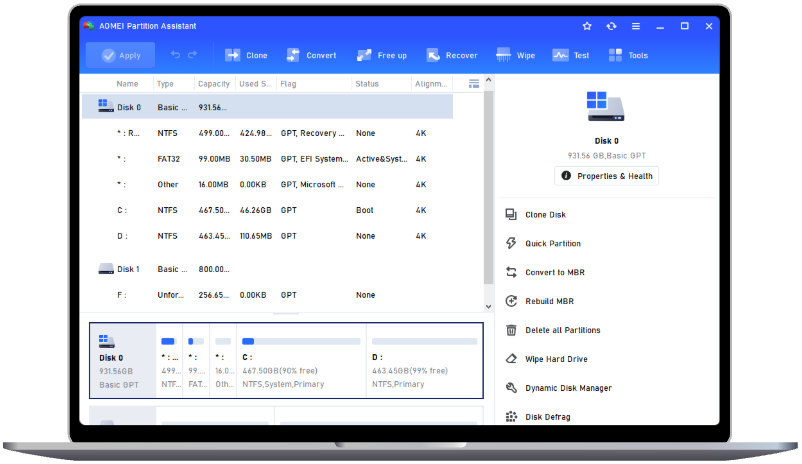
AOMEI Partition Assistant Professional offers a comprehensive suite of tools for managing disk partitions and optimizing storage resources effectively. With its intuitive interface and robust features, AOMEI Partition Assistant empowers users to:
- Resize and Move Partitions: Easily adjust partition sizes and relocate data to optimize disk space utilization.
- Merge and Split Partitions: Seamlessly merge or split partitions to accommodate evolving storage requirements without data loss.
- Convert Disk and Partition: Convert between different disk and partition formats, ensuring compatibility and flexibility.
- Clone Disk and Partition: Effortlessly clone entire disks or individual partitions for data backup, migration, or system replication purposes.
- Securely Wipe Data: Permanently erase sensitive data from disks or partitions to prevent unauthorized access or data breaches.
Technical Terms Deciphered:
- SATA: Serial Advanced Technology Attachment, a standard interface used for connecting storage devices to a computer's motherboard.
- BIOS: Basic Input/Output System, a firmware interface responsible for initializing hardware components and launching the operating system during the boot process.
- UEFI: Unified Extensible Firmware Interface, a modern replacement for BIOS, providing enhanced features and improved security in system firmware.
- Device Manager: A Windows utility for managing hardware devices and their associated drivers, allowing users to troubleshoot and configure system components.
- Driver: Software that facilitates communication between hardware devices and the operating system, enabling proper functionality and compatibility.
Tips for Success:
- Regular Maintenance: Perform routine checks and maintenance tasks to ensure optimal system performance and reliability.
- Stay Updated: Keep device drivers, firmware, and system software up to date to leverage the latest features and security enhancements.
- Backup Data: Implement a robust data backup strategy to safeguard against data loss due to hardware failures or software issues.
Conclusion
In conclusion, addressing the challenge of Windows 10 failing to recognize a second hard drive requires a methodical approach and a keen understanding of underlying hardware and software factors. By following the troubleshooting steps outlined above and leveraging tools like AOMEI Partition Assistant Professional, users can overcome detection issues and optimize storage management effectively.
FAQs
Q: Why isn't my second hard drive detected in Windows 10? A: Secondary hard drive detection issues in Windows 10 can stem from factors such as faulty connections, outdated drivers, or misconfigured BIOS/UEFI settings.
Q: How do I update device drivers in Windows 10? A: To update device drivers in Windows 10, navigate to Device Manager, right-click on the device, and select "Update driver" to search for and install the latest drivers automatically.
Q: Can I use AOMEI Partition Assistant to resize partitions without losing data? A: Yes, AOMEI Partition Assistant Professional allows users to resize partitions without data loss, providing a safe and efficient solution for disk management tasks.
Q: What is the difference between BIOS and UEFI? A: BIOS (Basic Input/Output System) and UEFI (Unified Extensible Firmware Interface) are firmware interfaces responsible for initializing hardware components during the boot process, with UEFI offering enhanced features and capabilities compared to traditional BIOS.
Q: Is it necessary to back up data before performing disk management tasks? A: Yes, it's essential to back up data before performing disk management tasks to prevent data loss in the event of unexpected errors or failures during the process.