AOMEI Partition Assistant
Resolving Windows 10 Update Error 0x800f0922
Discover troubleshooting methods to resolve Windows 10 update error 0x800f0922 and ensure successful system updates.

By Irene / Updated on February 21, 2024


In the realm of Windows 10 updates, encountering error code 0x800f0922 can be a frustrating experience for users. This article aims to delve into the intricacies of this issue, exploring its causes and providing practical solutions to resolve it effectively.
Understanding the Windows 10 Update with Error Code 0x800f0922 Issue
The Windows 10 update with error code 0x800f0922 issue typically arises when users attempt to install or download updates for their operating system. This error often indicates a problem with the installation process, preventing users from successfully updating their Windows 10 systems.
Identifying the Causes
Several factors may contribute to the occurrence of the Windows 10 update error 0x800f0922:
-
Corrupted System Files: In some cases, corrupted system files within the Windows operating system can interfere with the update process, leading to error code 0x800f0922.
-
Incomplete Update Downloads: If an update download is interrupted or incomplete, it can trigger the error code 0x800f0922 during the installation phase.
-
Disk Space Limitations: Insufficient disk space on the system drive can hinder the installation of Windows updates, resulting in the occurrence of error 0x800f0922.
Solutions to Resolve the Issue
To address the Windows 10 update with error code 0x800f0922 problem, users can implement the following solutions:
-
Run the Windows Update Troubleshooter:
- Navigate to Settings > Update & Security > Troubleshoot.
- Select Windows Update Troubleshooter and follow the on-screen instructions to detect and resolve any issues with the update process.
-
Clear the Windows Update Cache:
- Press Win + R, type "services.msc," and press Enter.
- Locate the Windows Update service, right-click on it, and select Stop.
- Navigate to C:\Windows\SoftwareDistribution and delete all files and folders within this directory.
- Restart the Windows Update service and attempt to install updates again.
-
Free Up Disk Space:
- Use Disk Cleanup to remove temporary files and unnecessary system files that may be consuming disk space.
- Uninstall unused applications and move personal files to an external storage device to free up additional space on the system drive.
-
Perform a System File Check (SFC) Scan:
- Open Command Prompt as an administrator.
- Type "sfc /scannow" and press Enter to initiate the scan.
- Allow the scan to complete, and follow any on-screen prompts to repair corrupted system files.
-
Disable Third-Party Security Software:
- Temporarily disable third-party antivirus or firewall software that may be interfering with the update process.
- Once updates are successfully installed, re-enable the security software to ensure system protection.
Recommendation: AOMEI Partition Assistant Professional
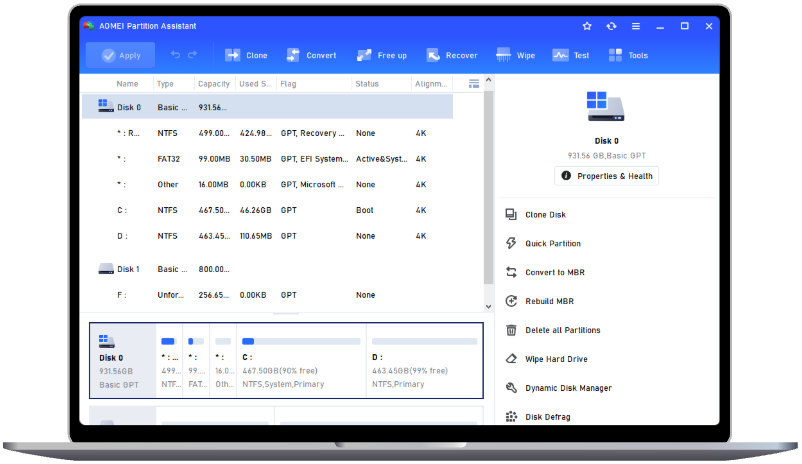
AOMEI Partition Assistant Professional offers a comprehensive solution for managing disk partitions and optimizing system performance. With features such as partition resizing, disk cloning, and OS migration, AOMEI Partition Assistant Professional provides users with the tools they need to maintain system stability and efficiency.
Key Features:
- Partition Management: Easily create, resize, merge, split, and format partitions.
- Disk Clone: Clone entire disks or partitions to upgrade storage devices or migrate operating systems.
- OS Migration: Transfer the operating system to a new SSD or HDD without reinstalling Windows.
- Secure Data Management: Ensure data security with features such as partition alignment and disk surface test.
How to Use AOMEI Partition Assistant Professional:
- Download and install AOMEI Partition Assistant Professional from the official website.
- Launch the application and select the desired partition or disk operation from the main interface.
- Follow the on-screen instructions to perform the desired partition or disk management task.
- Review the changes and confirm the operation to apply the modifications to the system.
Explaining Tech Terms
Before concluding, let's clarify five tech terms related to the Windows 10 update error 0x800f0922 issue:
- System Files: Essential files required for the proper functioning of the Windows operating system.
- Disk Space: The amount of storage capacity available on a hard disk drive or solid-state drive.
- Windows Update Troubleshooter: A built-in tool in Windows 10 designed to diagnose and resolve issues with the Windows Update service.
- Disk Cleanup: A utility in Windows used to free up disk space by deleting temporary files and unnecessary system files.
- System File Check (SFC) Scan: A command-line utility in Windows that scans and repairs corrupted system files.
Tips to Prevent Future Issues
- Regularly check for Windows updates and install them promptly to ensure system security and performance.
- Maintain sufficient disk space on the system drive to accommodate updates and prevent installation errors.
- Create regular backups of important data to safeguard against data loss in the event of update-related issues.
Conclusion
In conclusion, resolving the Windows 10 update with error code 0x800f0922 issue requires a systematic approach and careful troubleshooting. By following the solutions outlined in this guide and leveraging tools like AOMEI Partition Assistant Professional, users can effectively address update-related errors and maintain the stability and performance of their Windows 10 systems.
FAQs About Windows 10 Update with Error Code 0x800f0922 Issue
Q: How do I fix error code 0x800f0922 on Windows 10?
A: Refer to the solutions outlined in this article, including running the Windows Update Troubleshooter and clearing the Windows Update cache.
Q: Why am I getting error 0x800f0922 when trying to update Windows 10?
A: Error code 0x800f0922 typically indicates issues with the Windows Update process, such as corrupted system files or insufficient disk space.
Q: Can I manually download and install Windows 10 updates to bypass error code 0x800f0922?
A: While manual update installation is possible, it may not necessarily resolve error 0x800f0922. It's recommended to follow the troubleshooting steps outlined in this article.
Q: Will resetting Windows 10 resolve error code 0x800f0922?
A: While resetting Windows 10 can potentially resolve certain system-related issues, it should be considered as a last resort after exhausting other troubleshooting methods outlined in this article.
Q: Can disk fragmentation contribute to error 0x800f0922 on Windows 10?
A: Disk fragmentation itself is unlikely to directly cause error 0x800f0922. However, optimizing disk performance through defragmentation can help maintain system efficiency and prevent potential issues in the long run.