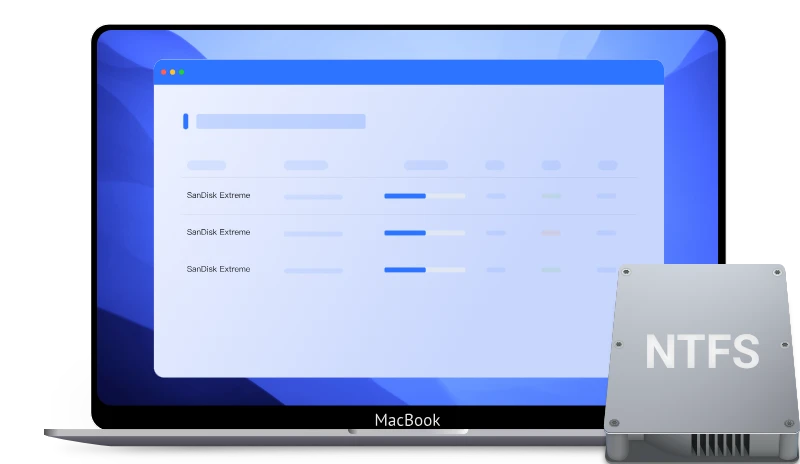
PartitionAssistant NTFS for Mac
NTFS for Mac OS Guide: How to Use NTFS on Mac
Can I use NTFS on Mac with full write access? Yes! Here you can discover how to use NTFS on Mac (M1/M2/Intel) safely. Use PartitionAssistant to read, write, add manage Windows drives seamlessly on macOS.

By Lucas / Updated on March 2, 2026


Can I use NTFS on Mac effectively?
Data exchange between Windows and Apple operating systems is a daily necessity for many professionals. However, a common hurdle arises when you plug a Windows-formatted drive into a MacBook. You can see your files, but you cannot edit them, delete them, or add new ones.
This comprehensive guide will explain the technical barriers between the two operating systems and provide you with authoritative methods on how to use NTFS on Mac. Whether you are dealing with a USB flash drive or a high-capacity SSD, we will show you how to use NTFS on Mac without formatting, ensuring your data remains safe and accessible.
6 Ways: How to Use NTFS on Mac
It is possible to use NTFS on Mac even if it doesn't support this file system natively. We have made a list of several methods to help you choose a way to use NTFS on a Mac.
Solution 1. Use NTFS on Mac via NTFS Tool
When looking for a tool to use NTFS on your Mac, you can't do better than PartitionAssistant NTFS for Mac. It is a lightweight and dedicated NTFS tool that allows you to use NTFS through a few simple clicks. With this tool, reading and writing on NTFS devices becomes straightforward. Moreover, using this tool, you can mount and unmount NTFS Windows drives from Mac's status bar.
PartitionAssistant NTFS for Mac is not only the easiest way to use NTFS on Mac but also the safest way. It ensures that your data isn't damaged when moving data to or from NTFS drives on Mac. Furthermore, this tool gives you the fastest interaction speed with NTFS drives.
 100% Secure
Before we start, you need to configure Security Policy in iOS Recovery Mode.
Step 1. You can install and run PartitionAssistant NTFS for Mac and connect your NTFS device.
Step 2. Your connected, removable, and external drives will be mounted and listed.

Step 3. Select the drive you want to operate and click "Open". Then you use all your NTFS drive on your Mac.
After all operations are complete, please click "Eject" to disconnect the external hard drive from your Mac.
Solution 2. Use NTFS on Mac via Mac Terminal Command
Mac Terminal requires you to run commands, and you should use this method if you are comfortable using Terminal.
Step 1: Launch Terminal on your Mac through Launchpad from the Dock. Now connect your NTFS drive to the Mac and run the following command in Terminal:
sudo nano /etc/fstab
Step 2: It will open the list of all NTFS files currently your Mac is recognizing. Now scroll down and run the following command:
LABEL=NAME none ntfs rw, auto, nobrowse (Replace "NAME" with your NTFS drive name)
Step 3: First, use the "Ctrl + O" key to save and then "Ctrl + X" to exit. Afterward, disconnect and reconnect the NTFS drive and "Go" from the top menu. Here, in the dropdown menu, select "Go to Folder."
Step 4: In the "Go to Folder" tab, type "/Volumes/NAME" by replacing the "NAME" with your NTFS drive name and press the "Return" key to access the drive. Now you can read and write on an NTFS drive.
Solution 3. Use NTFS on Mac via VM
Because NTFS is the product of Microsoft and is the default file system of Windows, you can install Windows using a virtual machine on your Mac. VM is an excellent tool for dealing with NTFS files regularly. Here is how to use NTFS on Mac in a virtual machine:
Step 1: You need to download the latest version of VirtualBox on your Mac and install it. Select "Move to Trash" to remove useless files. Now launch the VirtualBox through Applications and click "New."
Step 2: Now, name the new operating system, define the location for "Machine Folder," and select the operating system "Type" and "Version." Then, click "Continue" and allocate RAM to the virtual machine on the next screen.
Step 3: After deciding on the RAM, click "Continue" and next choose the hard disk. If it is your first time, select "Create a Virtual Hard Disk Now" and tap "Create." Afterward, select the type of hard disk as "VHD" and press "Continue."
Step 4: You can choose "Dynamically Allocated" or "Fixed," depending on your needs. Then, download the Windows ISO file from Microsoft and hit "Start" in the virtual machine you created.
Step 5: The tool will automatically detect the Windows ISO file if it doesn't add it manually and set up your Windows machine. After that, you can connect the NTFS hard disk to use NTFS on Mac.
Solution 4. Use NTFS on Mac via macFUSE (Free & Open-Source)
If you prefer not to use a virtual machine or a paid driver, free open-source alternatives are available. The most popular combination is macFUSE paired with NTFS-3G.
Important Warning: This method is complex and involves using the Terminal. It also requires disabling macOS security features (SIP), which can expose your system to vulnerabilities. Additionally, on Macs with Apple Silicon (M1/M2/M3), you must enable third-party kernel extensions in Recovery Mode for this to work.
Step 1: Install Xcode Command Line Tools
- Launch Terminal (Applications > Utilities > Terminal) and run the following command to install the necessary Xcode tools: xcode-select --install
- Click "Install" when the pop-up window appears.
Step 2: Install Homebrew
Homebrew is a package manager that simplifies installing software on macOS. Run this command to install it (copy and paste the entire line):
/bin/bash -c "$(curl -fsSL https://raw.githubusercontent.com/Homebrew/install/HEAD/install.sh)"
Step 3: Install macFUSE and NTFS-3G
Once Homebrew is ready, use it to download and install the necessary drivers. Run these commands one by one:
brew install --cask macfuse
brew install ntfs-3g
Step 4: Disable System Integrity Protection (SIP)
To allow these drivers to interact with the system, you must disable SIP.
Restart your Mac. Enter Recovery Mode:
- Intel Macs: Hold Command + R immediately after the Apple logo appears.
- Apple Silicon Macs: Press and hold the Power button until "Loading startup options" appears, then select Options.
In Recovery Mode, go to the top menu: Utilities > Terminal. Run the following command: csrutil disable
Now, Reboot your Mac normally.
Step 5: Create the Mount Script
Note: On macOS Catalina (10.15) and later, the system volume is read-only. The command below creates a symlink to force the system to use NTFS-3G for mounting drives.
Open Terminal and run the following commands to back up the original mounter and link the new one:
- sudo mv /sbin/mount_ntfs /sbin/mount_ntfs.original
- sudo ln -s /usr/local/sbin/mount_ntfs /sbin/mount_ntfs
Once completed, your NTFS drives should mount with write capabilities automatically. If you encounter errors regarding "Read-only file system" in Step 5, it means your macOS version (Big Sur/Monterey/Sonoma/Sequoia) strictly protects the /sbin folder, and you may need to mount drives manually using the ntfs-3g command instead.
Solution 5. Use NTFS on Mac via Boot Camp
If you have to use NTFS files regularly but don't want to use a VM, you can install Windows on your Mac. Apple provides a dedicated utility called Boot Camp to facilitate the installation of Windows. You will need to use the Administrator profile and have the MacBook updated to the latest version.
Step 1: Start by downloading the ISO file for Windows from the Microsoft website. After it is downloaded, launch Boot Camp Assistant from "Utilities" in "Applications" on your Mac. Finally, press "Continue" on the intro screen to initiate the process.
Step 2: Now, choose the Windows ISO image and define the partition where you want the Windows to be installed. If you have only one internal disk, use the divider to allocate space to Windows. You need at least 20 GB, while recommended amount is 55 GB.
Step 3: In case of more than multiple internal disks, choose the desired one and follow on-screen instructions to format the disk. Afterward, follow the instruction to install Windows on your Mac. Once Windows is installed, the Boot Camp on Mac will begin.
Step 4: Install the Boot Camp using the on-screen instructions. Your Mac will restart automatically with Windows. Now connect the NTFS drive to the Mac to access the files.’
Solution 6. Move NTFS Files to the Cloud
While you might need clarification about whether can Mac use NTFS, the one thing where you can access and share NTFS files with surety is a cloud service. You can upload the NTFS files through any cloud service like iCloud, Google Drive, or OneDrive. Since iCloud is the default service for Mac users, it is recommended. You can use these steps to move NTFS files to the cloud:
Step 1: After installing Windows on your Mac, open your Windows drive in Finder to access iCloud. Here, copy and paste the NTFS files to the iCloud drive.
Step 2: The files will automatically sync to iCloud once you have copied the files in the drive. To share the file through a link, right-click on the file and select "Share."
Solution 7. Use NTFS on Mac by Formatting
If the external storage drive matters, not the data, you can format the external hard disk on Mac with a more suitable file system like exFAT Mac. Your Mac provides full support for these file systems, and you can easily read or write files from your external storage drive. The steps needed to use NTFS on Mac by formatting drive are following:
Step 1: After connecting your NTFS hard drive to the Mac, navigate to "Disk Utility" through "Utilities" in the "Applications" and launch it. Select the NTFS drive and click "Erase" from the top bar.
Step 2: In the formatting windows, tap the "Format" option and select your desired file system. Afterward, tap "Erase" to start the formatting process.
100% SecureTo Sum Up
The friction between Windows and Apple file systems is a common frustration, but it is easily solvable. While the answer to "Can I use NTFS on Mac?" is a qualified "yes," the native read-only limitation makes it impractical for daily work.
Instead of risking your data with unstable Terminal commands or erasing your drive to change formats, the best approach for learning how to use NTFS on Mac is to utilize professional tools. PartitionAssistant NTFS for Mac offers a secure, user-friendly, and powerful way to gain full read-write access. By supporting the latest M1/M2 chips and macOS versions, it ensures that your data flows freely across platforms without the need for formatting.
FAQs
Q1: Why can't I write to my NTFS drive on Mac without software?
A: Can NTFS be used on Mac natively? Only for reading. Apple disables write support for NTFS by default due to licensing issues and stability concerns. To write data, you need a third-party driver like PartitionAssistant NTFS for Mac.
Q2: Does "how to use NTFS on Mac without formatting" mean my data is safe?
A: Yes. "Without formatting" means you do not need to erase your drive to change the file system (e.g., to exFAT). By using NTFS for Mac software, you keep the existing file system and all your files while gaining the ability to edit them.
Q3: Will PartitionAssistant NTFS for Mac work on macOS Sonoma?
A: Yes. PartitionAssistant NTFS for Mac is fully compatible with macOS 12 and later, which includes recent updates like Ventura and Sonoma.
Q4: Can I use this software for SD cards and USB sticks?
A: Absolutely. The software supports a wide range of storage devices including HDDs, SSDs, USB flash drives, SD cards, and CF cards, provided they are formatted with NTFS, FAT32, or exFAT.
Q5: Is it safe to use third-party NTFS software?
A: Yes, using reputable software like PartitionAssistant is much safer than using experimental Terminal commands. The software uses stable drivers to ensure data integrity and includes a "Safe Eject" feature to prevent corruption.