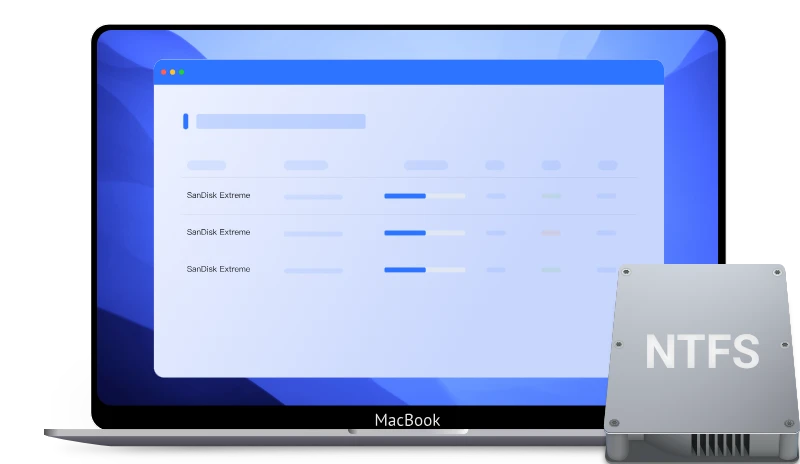
PartitionAssistant NTFS for Mac
A Guide to Microsoft NTFS for Mac
Unlock full read-write capabilities for NTFS drives on macOS. Discover the best NTFS for Mac software for Intel and M1/M2 Macs. This guide shows you how to use PartitionAssistant to manage, rename, and transfer files easily.

By Lucas / Updated on March 2, 2026


Whether you are a video editor moving footage, an IT professional managing backups, or a student sharing documents, you have likely encountered the friction between Windows and macOS. The core of this friction usually lies in the file system. When you plug a drive formatted on Windows into a Mac, you often hit a wall: you can see your files, but you cannot edit, copy to, or delete them. This is where Microsoft NTFS for Mac solutions come into play.
This article serves as a comprehensive guide to understanding this compatibility gap. We will explore what NTFS for Mac is, why the restriction exists, and provide authoritative methods—ranging from system commands to professional NTFS for Mac software—to help you gain full control over your external storage.
What is Microsoft NTFS for Mac?
Before diving into the solutions, it is crucial to understand the technology behind the problem. What is NTFS for Mac, and why is it essential for cross-platform workflows?
NTFS (New Technology File System) is the proprietary file system created by Microsoft. It is the standard format for Windows system drives and most external hard drives formatted on a PC. It offers advanced features like journaling and large file support. However, because it is a Microsoft technology, macOS does not fully support it out of the box.
"Microsoft NTFS for Mac" generally refers to the drivers or third-party software that bridge the gap between the Apple operating system and the Windows file system. By default, macOS can read NTFS drives—meaning you can open files and copy them to your Mac—but it cannot write to them. This means you cannot save new files to the drive, edit existing ones, or delete clutter. To perform these actions, you need a specialized tool or driver that translates macOS commands into a language the NTFS drive understands.
How to Perform Microsoft NTFS for Mac File Operations
To bypass the "Read-Only" limitation and fully utilize your drive, you have two primary paths. You can attempt to use hidden experimental features within macOS (often sought after as free NTFS software for Mac alternatives), or you can utilize dedicated, professional software designed for stability and modern hardware.
Method 1: Using Terminal to Enable Native Support (Experimental)
Apple does include a hidden, experimental ability to write to NTFS drives, but it is disabled by default for a reason: it is unstable and can lead to data corruption. While some users look for free NTFS software for Mac, this system-level tweak is the closest native option, though it is risky.
Note: Proceed with caution. This method is technical and not recommended for critical data.
Step 1. Go to Applications > Utilities > Terminal. Type the command sudo nano /etc/fstab and press Enter. You will be asked for your administrator password.

Step 2. In the editor, type the following line:
LABEL=DRIVENAME none ntfs rw, auto,nobrowse
(Replace "DRIVENAME" with the exact name of your external drive. If the name has spaces, use \040 instead of a space).
Step 3. Press Ctrl + O to save the file, then Ctrl + X to exit the editor. Eject your external drive and plug it back in.
Step 4. Because of the "nobrowse" flag, the drive will not appear on the desktop. You must open Finder, select "Go to Folder" (Cmd + Shift + G), and type /Volumes to find it.
While this allows you to perform basic Microsoft NTFS for Mac write operations without third-party tools, it is cumbersome and prone to failure on newer macOS versions.
Method 2: The Professional Solution with PartitionAssistant NTFS for Mac
For a reliable, seamless, and safe experience, using professional NTFS for Mac software is the industry standard. A leading solution in this space is PartitionAssistant NTFS for Mac.
PartitionAssistant NTFS for Mac is a newly developed, robust software designed specifically for the Apple ecosystem. It eliminates the need for complex command-line work and provides instant, stable read-write access to your Windows drives. Unlike the experimental system method, this tool is engineered to handle data safely, ensuring you can read, write, delete, rename, and move files and folders on NTFS drives directly within the macOS Finder, just as if it were a native Apple drive.
This software stands out due to its broad compatibility. It supports a wide array of storage devices, including traditional HDDs, modern SSDs, USB flash drives, and even SD and CF cards. Furthermore, it is not limited to just NTFS (supporting versions from Windows NT 3.1 to 11); it also provides robust management for FAT32 and exFAT file systems. Crucially for modern Apple users, it fully supports macOS 12 and later, running natively on both Intel-based Macs and the newer Apple Silicon (M1/M2) Macs.
 100% Secure
Before we start, you need to configure Security Policy in iOS Recovery Mode.
Step 1. Run Partition Assistant NTFS for Mac and connect your NTFS hard drive or USB flash drive.
Step 2. The connected, removable, and external USB drives will be mounted and listed.
Step 3. Select the drive you want to operate and click "Open".
Step 4. Now you can copy files on your Mac and click "Paste Item" to copy the files to USB drive.
Step 5. You can also copy, delete, and rename files on the USB drive.
Step 6. After all operations are complete, please click "Eject" to disconnect the USB drive from your Mac.
PartitionAssistant is more than just a driver; it is a management tool. It includes a safe ejection feature that ensures all data is written before the drive is disconnected, preventing corruption. It also allows you to view detailed disk properties and check the health of the file system, giving you peace of mind regarding the physical state of your storage media.
To sum up
The inability to write to Windows drives on a Mac is a common headache caused by file system licensing and architecture. While understanding what NTFS for Mac is helps clarify why the issue exists, the solution lies in choosing the right tool. While you can attempt to use free NTFS software for Mac hacks via the Terminal, the risks to your data stability are significant.
For a secure and efficient workflow, employing professional NTFS for Mac software like PartitionAssistant NTFS for Mac is the authoritative choice. By supporting the latest hardware (M1/M2 chips) and operating systems (macOS 12+), and enabling full file manipulation capabilities (write, delete, move), it ensures that the "Read-Only" error becomes a thing of the past. Whether you are a casual user or a professional, this tool bridges the gap between Microsoft and Apple, allowing for seamless data transfer.