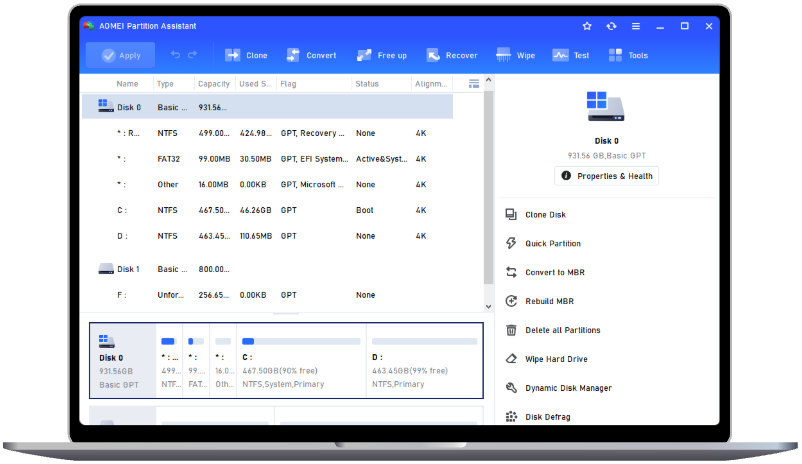
AOMEI Partition Assistant
Troubleshooting Guide: What to Do When "Attach VHD" is Greyed Out
Solve the 'Disk Management attach vhd greyed out' problem with our step-by-step troubleshooting guide. Learn how to fix permission issues, check the Virtual Disk service, and use powerful tools to mount your VHD file.

By Lucas / Updated on November 11, 2025


Virtual Hard Disks (VHDs) are an incredibly versatile tool for system administrators, developers, and tech enthusiasts. They allow you to create a virtualized hard disk within a single file, perfect for testing software, managing multi-boot environments, or backing up systems. However, a common frustration can bring your workflow to a halt: navigating to Disk Management to mount a VHD, only to find the "Attach VHD" option is greyed out.
This issue can be a significant roadblock, preventing you from accessing the data or operating system within your virtual disk. This comprehensive guide will explain the common reasons why the "Attach VHD" option is disabled in Windows 10 and provide you with clear, step-by-step solutions to fix it, using both native Windows tools and a powerful third-party alternative.

Why is "Attach VHD" Greyed Out?
When you find that the "Attach VHD" option is unavailable, it's typically a sign that the operating system is preventing the action for a specific reason. This section will explore the most common culprits behind this issue.
The primary reason you'll encounter a greyed-out "Attach VHD" button is a lack of administrative privileges. Disk Management is a powerful utility that makes significant changes to your system's storage configuration. To prevent unauthorized or accidental changes, Windows requires that these operations be performed with elevated permissions. If you open Disk Management as a standard user, many of its functions, including attaching virtual disks, will be disabled.
Another potential cause is an issue with the "Virtual Disk" service. This is a crucial background service in Windows that is responsible for providing management services for virtual and physical disks. If this service is stopped, disabled, or has encountered an error, Disk Management will lose the ability to perform VHD-related tasks, resulting in the "Disk Management attach VHD greyed out" problem. In some rare cases, the VHD file itself might be corrupted or located in a protected directory, making it inaccessible.
How to Fix "Disk Management Attach VHD Greyed Out"?
Resolving this issue is usually straightforward. The following methods will guide you through the most effective solutions, starting with the simplest fixes using built-in Windows tools and moving to a more advanced, user-friendly software solution.
Method 1: Using Built-in System Tools
Before turning to third-party software, it's best to try the tools already available in your Windows operating system. These methods resolve the issue in the vast majority of cases.
This is the most common and effective solution for when the attach VHD greyed out in Windows 10. By ensuring Disk Management has the necessary permissions, you can unlock its full functionality.
1. Run Disk Management as administrator
Step 1. Click on the Start button or press the Windows key.
Step 2. Type "Disk Management" into the search bar.
Step 3. The best match will be "Create and format hard disk partitions." Right-click on it.
Step 4. From the context menu, select "Run as administrator."
Step 5. If prompted by User Account Control (UAC), click "Yes."
Once Disk Management opens with elevated privileges, navigate to the "Action" menu. The "Attach VHD" option should now be available for you to select.
2. Check Service Status
If running as an administrator doesn't solve the problem, the next step is to ensure the essential underlying service is running correctly.
Step 1. Press the Windows key + R to open the Run dialog box. Type services.msc and press Enter.
Step 2. In the Services window, scroll down and locate the "Virtual Disk" service.
Step 3. Double-click on it to open its properties. Check the "Service status." If it is "Stopped," click the "Start" button.
Step 4. Ensure the "Startup type" is set to "Manual" or "Automatic." If it's set to "Disabled," change it.
Step 5. Click "OK" and close the Services window. Try opening Disk Management again to see if the issue is resolved.
3. Use DiskPart
For users comfortable with the command line, DiskPart offers a powerful and direct alternative to the graphical interface of Disk Management.
Step 1. Click the Start button, type cmd, right-click on "Command Prompt," and select "Run as administrator."
Step 2. Type diskpart and press Enter to start the utility.
Step 3. Use the select vdisk command, providing the full path to your VHD file. For example: select vdisk file="C:\MyVHDs\test.vhd"
Step 4. Once the VHD is selected, type the following command and press Enter: attach vdisk
Step 5. DiskPart will mount the VHD, and it will then appear in both Disk Management and File Explorer.
Method 2: A Superior Management Experience with AOMEI Partition Assistant Professional
While the built-in tools can solve the "attach vhd greyed out" issue, managing the virtual disk afterward in Disk Management can be limiting. For a more intuitive and feature-rich experience, a professional tool like AOMEI Partition Assistant Professional is an excellent choice. This comprehensive computer management software is designed to handle all aspects of disk and partition management for both physical and virtual disks through a clean, user-friendly graphical interface.
AOMEI Partition Assistant Professional simplifies complex tasks and provides functionality that goes far beyond what native Windows tools offer. After you have successfully attached your VHD using one of the methods above, AOMEI Partition Assistant can take over to make managing it effortless. For example, creating and formatting partitions on the newly attached virtual disk is a breeze.
 100% Secure
Step 1.Click "Attach VHD". Select the "Attach VHD" option after clicking the"Virtual Disk" tab.
Step 2. Browse and Select VHD File. Click "Browse" to locate the location where the .vhd or .vhdx file is saved. Select the .vhd or .vhdx file you want to attach and click "Open" to attach it.
Step 3. Start Attach VHD. Once the virtual file is selected, you can click "OK" to start attaching the VHD.
Step 4. Attach VHD Successfully. Once the process is finished, you will see that the VHD is attached successfully.
Beyond basic VHD management, AOMEI Partition Assistant Professional is a complete toolkit with other handy functions, such as migrating your entire operating system to an SSD, cloning disks, converting between MBR and GPT partition styles without deleting data, and recovering lost partitions.
To sum up
The "Attach VHD greyed out" issue in Windows is a common but very solvable problem. It almost always stems from not running Disk Management with the necessary administrative rights or from a stopped Virtual Disk service. By following the methods outlined—running as an administrator, checking the system service, or using the powerful DiskPart utility—you can quickly regain access to your virtual disks.
For users who want to move beyond the basics and manage their disks with greater ease and flexibility, AOMEI Partition Assistant Professional provides a superior, user-friendly interface packed with advanced features that streamline the entire process.