AOMEI Partition Assistant
VHD vs. VHDX: A Guide to Convert VHD to VHDX and Back
Need to vhdx convert to vhd for compatibility or upgrade to VHDX for performance? Discover the best tools and methods to convert your virtual disks in Windows 10/11, including a powerful cloning solution.

By Lucas / Updated on November 17, 2025


In the realm of virtualization and modern system management, Virtual Hard Disks (VHDs) have become an indispensable tool. They allow you to encapsulate an entire disk within a single file, making it easy to create backups, test software in isolated environments, and manage multi-boot systems. With the evolution of Windows, a newer format, VHDX, was introduced, offering significant advantages over its predecessor.
This guide will dive deep into the differences between these two formats and provide a detailed, step-by-step tutorial for converting VHD to VHDX. We will also cover the reverse process, showing you how to convert VHDX to VHD for backward compatibility, using both native Windows tools and a professional third-party disk manager.
What's the difference between VHD and VHDX?
Understanding the key differences between these two formats is crucial for deciding when and why you should convert them. This section breaks down their primary characteristics. The VHD (Virtual Hard Disk) format was the original standard, widely used in products like Microsoft Virtual PC and Windows 7's Native Boot feature. While reliable, it has some notable limitations in today's high-capacity storage landscape.
The VHDX (Virtual Hard Disk v2) format was introduced with Windows Server 2012 and Windows 8 to address the shortcomings of the VHD format. It is the preferred format for all modern virtualization tasks in Hyper-V.
Storage Capacity: This is the most significant difference. The VHD format has a maximum size limit of 2,048 GB (2 TB). In contrast, the VHDX format supports a massive 64 TB, making it suitable for large-scale applications and data storage.
Data Corruption Protection: VHDX includes a logging mechanism that protects against data corruption during unexpected power failures or system crashes. The VHD format lacks this robust protection, making it more vulnerable.
Performance: VHDX offers better performance, particularly for dynamically expanding disks. It uses a larger internal block size and an improved data structure, optimizing alignment with physical disks and reducing performance overhead.
Custom Metadata: The VHDX format allows developers to store custom metadata within the file, such as the OS version or patches applied, which is not possible with the older VHD format.
In short, you would convert VHD to VHDX to take advantage of larger capacity, better performance, and enhanced reliability. Conversely, you might need to convert to VHD if you need to use the virtual disk on an older system that does not support the VHDX format.
Can you convert VHD to VHDX?
Yes, you can easily convert between the VHD and VHDX formats. Windows provides powerful, built-in tools for this purpose, and third-party software can offer a more integrated management experience.
Method 1: Using Built-in Windows Tools (Hyper-V Manager and PowerShell)
1. Using Hyper-V to convert VHD
For users running Windows Pro, Enterprise, or Education editions, the Hyper-V feature includes excellent utilities for VHD conversion. Hyper-V Manager provides a straightforward graphical interface for editing and converting virtual disks. First, ensure the Hyper-V feature is enabled on your system. You can do this through "Turn Windows features on or off" in the Control Panel.
Step 1. Open Hyper-V Manager from the Start menu. In the Actions pane on the right, click "Edit Disk..."
Step 2. The "Edit Virtual Hard Disk Wizard" will open. Click "Next," then "Browse" to locate and select the VHD or VHDX file you want to convert.

Step 3. On the "Choose Action" screen, select the "Convert" option and click "Next." Choose the desired disk format. If you are converting a VHD, select VHDX. If you are converting a VHDX, select VHD.
Step 4. Select the disk type (Fixed size or Dynamically expanding). It's generally best to keep the same type as the source disk.
Step 5. On the "Configure Disk" screen, specify a new name and location for the converted file. Do not overwrite your original file.
Step 6. Review the summary and click "Finish." The wizard will create a new, converted copy of your virtual disk.
2. Run PowerShell commands
For a faster, command-line approach, PowerShell is the perfect tool.
Step 1. Open PowerShell as an administrator. To convert VHD to VHDX, use the Convert-VHD cmdlet with the following syntax:
Convert-VHD -Path "C:\Path\To\YourDisk.vhd" -DestinationPath "C:\Path\To\YourNewDisk.vhdx"
To convert VHDX to VHD, the command is very similar:
Convert-VHD -Path "C:\Path\To\YourDisk.vhdx" -DestinationPath "C:\Path\To\YourNewDisk.vhd"
Step 2. Press Enter, and PowerShell will handle the conversion process, showing a progress bar.
Method 2: A Flexible Cloning Approach with AOMEI Partition Assistant Professional
While the native tools are excellent for direct conversion, they operate outside the standard disk management interface. For users who prefer a comprehensive tool that handles all aspects of disk management in one place, AOMEI Partition Assistant Professional offers a powerful alternative. This software provides an intuitive, graphical interface for managing both physical and virtual disks with ease.
Instead of a direct conversion button, AOMEI Partition Assistant uses its robust "Disk Clone" feature to achieve the same result, giving you more control over the process. This method involves cloning the contents of your source VHD/VHDX to a new, blank virtual disk in the desired target format.
 100% Secure
Stage 1. Create a New Blank Virtual Disk
First, use Disk Management or PowerShell to create a new, empty VHD or VHDX file in the format you want to convert to. Make sure it is large enough to hold the data from the source disk.
Stage 2. Attach Both Disks
Attach both your original source VHD/VHDX and the new blank VHD/VHDX to your system.
Stage 3. Launch AOMEI Partition Assistant to clone disk
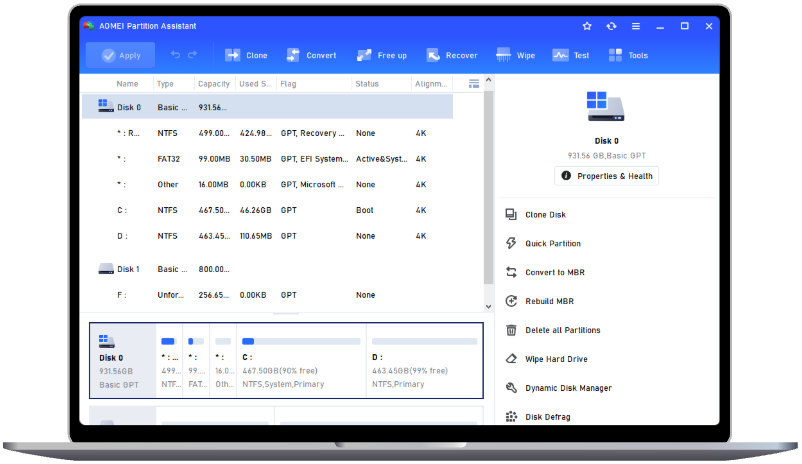
Step 1. Open the software. You will see both attached virtual disks listed alongside your physical drives.
Step 2. Start the Clone Wizard: Right-click the source virtual disk (the one you want to convert) and select "Clone Disk" from the menu.
Step 3. Select Destination Disk: Choose your new, blank VHD or VHDX as the destination disk.
Step 4. The software will display a preview of the operation. Click the "Apply" button in the top-left corner and then "Proceed" to begin cloning the data.
Ending
Choosing between VHD and VHDX depends on your needs: VHDX for modern performance and capacity, and VHD for legacy compatibility. Knowing how to convert VHD to VHDX and vice versa is an essential skill for any advanced Windows user. The built-in Hyper-V Manager and PowerShell cmdlets provide direct and efficient conversion methods.
For those who prefer a more integrated and user-friendly approach, AOMEI Partition Assistant Professional offers a powerful cloning solution that fits seamlessly into a complete disk management workflow, ensuring you can manage all your physical and virtual storage with confidence.