AOMEI Partition Assistant
Microsoft PC Manager Windows 11: A Handy Tool and a Better Alternative
Is the new PC Manager for Windows 11 enough? Our guide reviews Microsoft's tool and introduces a powerful alternative to extend partitions, clean junk files, and fix boot issues. Get the ultimate Windows 11 PC manager.

By Lucas / Updated on August 5, 2025


With the release of Windows 11, Microsoft introduced a new utility to help users maintain their system's health: Microsoft PC Manager. This lightweight, free tool aims to provide simple, one-click solutions for performance boosts and cleanup. But is it the only tool you need? While the Microsoft PC Manager for Windows 11 is a welcome addition, power users and those facing complex issues may find it lacking in depth and functionality.
This article will provide a complete overview of the official PC Manager, explore the inherent limitations of built-in Windows utilities, and introduce a far more powerful, all-in-one solution that can handle everything from advanced disk management to critical boot repairs.
Why do you need a Microsoft PC Manager for Windows 11?
This section explores the purpose and features of Microsoft's official utility, explaining why having a management tool is beneficial for everyday use.
As you use your computer, it naturally accumulates junk files, startup programs, and fragmented data, leading to slower performance. A PC manager for Windows 11 helps combat this digital decay. The official Microsoft tool provides a centralized dashboard for several key maintenance tasks:
Health Check: Scans for junk files, potential issues, and viruses with a single click.
Storage Management: Helps you perform a deep clean to remove temporary and system cache files. It also has a feature to find large files on your drives that may be taking up unnecessary space.
Process Management: Shows you which processes are using significant memory, allowing you to end them easily without opening Task Manager.
Startup Apps: A simple interface to disable applications that launch at boot, which can dramatically improve your computer's startup time.
For the average user, the Windows 11 PC manager offers a convenient way to perform basic housekeeping. If you're looking for the official version, you can find the PC manager download for Windows 11 directly from the Microsoft Store. However, when it comes to more complex tasks, especially disk management, you'll quickly run into its limits.
Help in Windows 11 Disk Management
Before we look at a better alternative, let's examine the default tool for managing partitions in Windows: Disk Management. This utility has limitations that often prevent users from organizing their storage as they wish.
Windows Disk Management (diskmgmt.msc) is a built-in utility that allows you to create, delete, format, and resize partitions. While functional for basic setups, its "Extend Volume" feature has a critical drawback: it can only extend a partition if there is contiguous (immediately adjacent) unallocated space to its right.
If the unallocated space is on the other side of another partition, the "Extend Volume" option will be grayed out and unusable. This common scenario forces users into a corner, unable to utilize free space effectively without deleting partitions, which is a risky and inconvenient process.
Better one-in-all Microsoft PC manager for Windows 11
This is where a truly comprehensive management suite shines. While the official Microsoft tool handles surface-level cleaning, a professional tool manages the very foundation of your system: your disk partitions and system integrity.
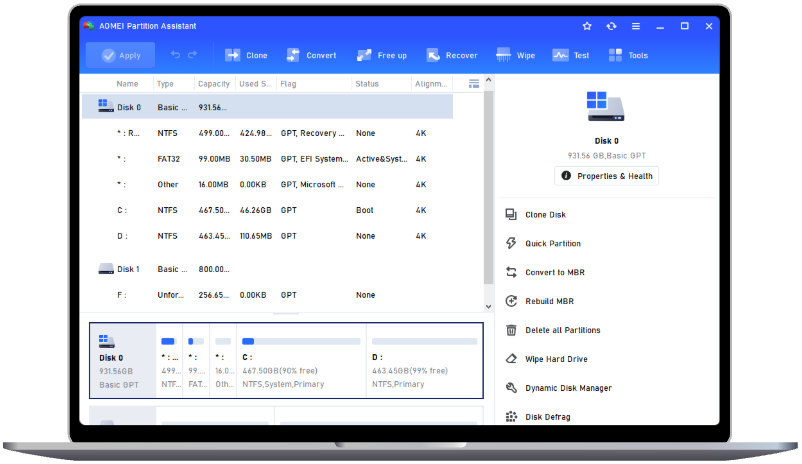
AOMEI Partition Assistant Professional is the ultimate all-in-one PC management solution that picks up where Microsoft's tools leave off. It's a robust, feature-rich disk manager designed for users of all skill levels, offering powerful solutions to common and complex problems alike. From overcoming Disk Management's limitations to offering advanced system repair and cleaning functions, it serves as the powerful, versatile PC manager that Windows 11 users truly need.
 100% Secure
Let's explore how AOMEI Partition Assistant Professional solves four common, challenging scenarios.
▶ Case 1: Extend partition when there is non-contiguous unallocated space
This is the classic problem where the built-in Disk Management fails. AOMEI's "Merge Partitions" feature solves this effortlessly.
Step 1. Install and launch AOMEI Partition Assistant Professional.

Step 2. Right-click the partition you want to extend (e.g., your C: drive) and select Merge Partitions.
Step 3. In the pop-up window, check the box for the partition you are extending and also check the box for the non-contiguous unallocated space.
Step 4. Click OK, and then click Apply in the top-left corner to execute the operation. The software will intelligently move the data and merge the space without any data loss.
▶ Case 2: Extend partition when there is no unallocated space [Advanced]
What if your disk has no unallocated space at all, but another partition has plenty of free room? AOMEI's "Allocate Free Space" feature makes this simple.
Step 1. Right-click the partition that has ample free space (e.g., D: drive) and select Allocate Free Space.
Step 2. Specify the amount of space you want to allocate and choose the target partition you want to extend (e.g., C: drive).
Step 3. Click OK to preview the result.
Step 4. Click Apply and Proceed to commit the changes. This powerful function directly transfers free space from one partition to another, a feat impossible with Windows tools.
▶ Case 3: Clean junk files to keep PC in a nice state
While Microsoft's PC Manager cleans files, AOMEI's "PC Cleaner" provides a deeper, more thorough scan to reclaim maximum disk space.
Step 1. In the main console of AOMEI Partition Assistant, click PC Cleaner from the Free up menu.
Step 2. Click Start Scan to allow the tool to search for all system and registry junk files across your PC.
Step 3. After the scan, review the files that can be deleted. The tool smartly pre-selects files that are safe to remove.
Step 4. Click Clean All to remove the junk files and free up valuable space, boosting your system's responsiveness.
▶ Case 4: Boot repair when PC meet boot issues
If your PC fails to start due to a corrupted Master Boot Record (MBR), you're often faced with a reinstall. AOMEI allows you to repair it without data loss.
Step 1. On a working PC, use AOMEI Partition Assistant to create a bootable USB drive via the Make Bootable Media feature.
Step 2. Insert the bootable USB into the malfunctioning PC and boot from it (you may need to change the boot order in the BIOS/UEFI).
Step 3. Boot the PC that cannot boot into WinPE. It will automatically load the Boot Repair tool and start the boot entries scan process. All boot entries will be displayed.
You can either repair to the current disk or repair to another disk. Repair to the current disk is recommended for common users.
Step 4. Select one/multiple repairable boot entries you want to repair and click the "Repair" button to start the boot repair.
Step 5. Click Apply to perform the repair. This often fixes "Operating System not found" or other boot-related errors.
Beyond these cases, AOMEI Partition Assistant Professional also includes other indispensable functions like Migrate OS to SSD, a full Disk Clone Wizard, the App Mover to transfer programs between drives, and the ability to convert disks between MBR and GPT without deleting data.
Ending
In summary, the official Microsoft PC Manager for Windows 11 is a decent starting point for basic system maintenance. It offers simple, accessible tools for cleaning files and managing startup apps. However, for users who demand true control over their system, its capabilities are limited. When you encounter frustrating disk management walls, need to perform a deep system clean, or are faced with critical boot errors, a professional-grade tool is necessary.
AOMEI Partition Assistant Professional stands out as a better, all-in-one solution. It not only masters advanced disk management with unparalleled ease but also provides robust cleaning and repair utilities, making it an essential toolkit for any serious Windows 11 pc manager. By empowering you to overcome built-in limitations, it ensures your PC runs optimally and securely for years to come.