AOMEI Partition Assistant
How to Download Windows 11 to a Separate Drive
Carry your personalized Windows 11 desktop in your pocket! Discover the benefits and follow our simple instructions to download Windows 11 onto a USB drive for ultimate portability and flexibility.

By Lucas / Updated on September 23, 2025


In today's fast-paced digital world, flexibility and portability are paramount. Imagine carrying your entire personalized Windows 11 environment—your apps, files, and settings—in your pocket and booting it up on almost any computer. This isn't science fiction; it's the power of having Windows 11 on a separate, portable drive.
Whether you're a developer needing a clean testing environment, a professional working across multiple locations, or simply someone who wants a backup OS, learning how to download Windows 11 to a separate drive is an invaluable skill.
This guide will explore the benefits of this setup and provide a clear, step-by-step process, highlighting a powerful tool that simplifies this task far beyond what native utilities can offer.
Why Download Windows 11 to a Separate Drive?
Before we get into the "how," let's explore the "why." This section covers the compelling reasons for creating a portable Windows 11 installation.
Ultimate Portability: With Windows 11 on an external drive (like a USB 3.0 stick or an external SSD), you can access your personal desktop, applications, and files on different computers at work, home, or while traveling. It's your OS, on your terms, anywhere you go.
Isolated Testing Environment: For developers, IT professionals, and tech enthusiasts, a portable Windows drive is a perfect sandbox. You can test new software, drivers, or even Windows Insider builds without risking the stability of your main installation.
Enhanced Security and Privacy: You can create a dedicated, secure environment for sensitive tasks like online banking or handling confidential work documents. This keeps your activities completely separate from the host machine's operating system.
Emergency Boot Disk: If your primary operating system fails to boot due to a virus, update error, or hardware issue, a portable Windows 11 drive can serve as a lifesaver, allowing you to access your files and troubleshoot the problem.
How to Download Windows 11 to a Separate Drive
In the era of Windows 10, Microsoft offered a feature called "Windows To Go" in its Enterprise and Education editions, which was designed for this exact purpose. However, Microsoft has since deprecated this feature, meaning there is no longer a simple, built-in tool in Windows 11 to create a portable, bootable OS.
While it is technically possible to do this, manually using command-line tools like DISM, the process is highly complex, time-consuming, and prone to errors. It requires a deep understanding of disk partitioning and command-line syntax, making it inaccessible for the average user. This is why a dedicated third-party solution is now the recommended path for any Windows 11 migration to a portable drive.

Alternative to Windows Migration Assistant: AOMEI Partition Assistant
Since a straightforward native tool is no longer available, we need a reliable third-party utility. This is where a comprehensive tool shines, acting as a superior alternative to any nonexistent Windows Migration Assistant for this task.
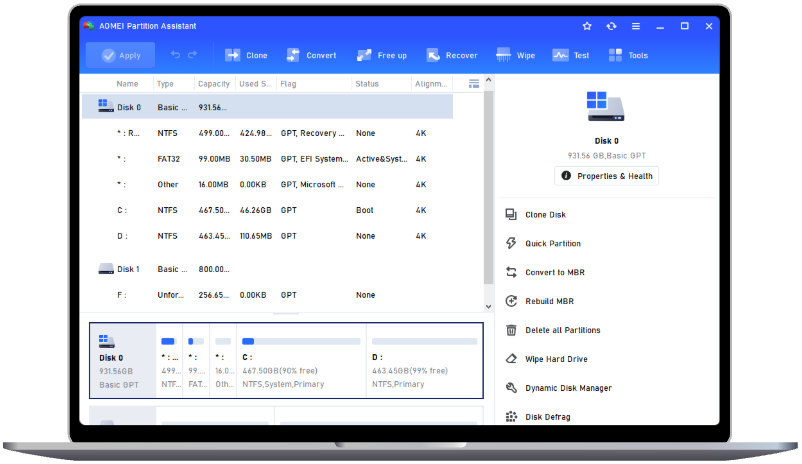
AOMEI Partition Assistant Professional is a powerful and versatile disk management suite that simplifies complex tasks into just a few clicks. It is highly regarded for its robust feature set and user-friendly interface. Among its many tools is the "Windows To Go Creator," a feature specifically designed to streamline the process of installing a full version of Windows onto a portable drive. It effectively resurrects the convenience of the old "Windows To Go" feature and makes it accessible to all Windows 11 users.
 100% Secure
Tips:
1. Download the official Windows 11 ISO file from the Microsoft website.
2. You will need a USB 3.0 or 3.1 drive (at least 64GB is recommended for good performance) or an external SSD.
Step 1. Install and launch AOMEI Partition Assistant Professional. In the main interface, click on "Tools" in the top menu and select "Windows To Go Creator".
Step 2. Choose "Create Windows ToGo for personal computer" and click "Next".
Step 3. In the next window, select the first option: "Create Windows ToGo with system disc/ISO". Click the folder icon to browse your computer and select the Windows 11 ISO file you downloaded earlier. Click "Next".
Step 4. The program will list available USB drives. Select your target USB drive from the list. The software will warn you that all data on the drive will be erased. Ensure you have backed up any important files, then click "Proceed" to begin.
AOMEI Partition Assistant will now handle the entire process of formatting the drive, extracting the Windows files, and making it bootable. This may take some time, depending on the speed of your USB drive and computer.
Once complete, you will have a fully functional, portable Windows 11 drive. To use it, plug it into any computer, restart the machine, and enter the BIOS/UEFI menu to set the USB drive as the primary boot device.
-
Migrate OS to SSD/HDD: Seamlessly transfer your current operating system to a new drive without reinstalling anything.
-
App Mover: Move installed applications from one drive to another to free up space.
-
PC Cleaner: Scan and remove junk files to optimize your system's performance.
To Sum Up
Learning how to download Windows 11 to a separate drive opens up a world of convenience, from having a portable workspace to creating a safe testing environment. While Microsoft has moved away from supporting a built-in tool for this, the task is far from impossible. The manual, command-line method is too complex for most, but a professional tool fills this gap perfectly.
AOMEI Partition Assistant Professional, with its "Windows To Go Creator," provides a straightforward, reliable, and efficient solution. It empowers any user to create a portable Windows 11 drive in just a few simple steps, making this advanced capability accessible to everyone.