AOMEI Partition Assistant
Decoding the Virtual Disk Service Error: A Guide to Flawless Disk Management
Troubleshoot common 'virtual disk service error' messages like 'the volume size is too big' or 'the service failed to initialize.' This guide provides clear solutions and introduces AOMEI Partition Assistant as a powerful alternative for easy disk management.

By Lucas / Updated on December 2, 2025


Navigating the complexities of Windows disk management is a crucial skill for maintaining a healthy and efficient computer. However, users often encounter roadblocks, such as the system getting stuck "connecting to Virtual disk service," or more explicit messages like a "virtual disk service error." These issues can halt essential tasks like formatting drives or creating partitions, causing significant frustration. This comprehensive article will demystify these errors, exploring the core question of "what is virtual disk service" and providing authoritative solutions to get your system back on track.
An Introduction to the Virtual Disk Service
Before diving into troubleshooting, it's vital to understand the service at the heart of these issues. This section will clarify what the Virtual Disk Service is and the critical role it plays in your Windows operating system.
The Virtual Disk Service (VDS) is a core Microsoft Windows service that acts as a unified command center for storage management. It provides the underlying application programming interface (API) that tools like the graphical Disk Management snap-in and the command-line utility DiskPart use to perform their functions.
Whether you're initializing a new disk, creating volumes, or managing complex hardware RAID arrays, VDS is the engine working behind the scenes. Its purpose is to abstract the complexities of various storage hardware, offering a consistent way for applications to interact with disks and volumes.
What Is DiskPart Virtual Disk Service Error?
When you use command-line tools like DiskPart, you might be confronted with a specific "virtual disk service error." This section explains why these errors occur and what they signify.
A DiskPart virtual disk service error indicates a problem that VDS has encountered while trying to execute a command. These errors are not random; they provide specific feedback about what went wrong. For instance, an error might state that an operation isn't allowed on the system's boot drive, that a disk is not convertible, or that the service itself failed to start.
Essentially, the command you issued to DiskPart was passed to VDS, and VDS was unable to complete the request for a specific reason, which it then reports back as an error message. Understanding the context of the error is the first step toward finding the correct solution.
Possible Virtual Disk Service Errors and Solutions
Encountering a virtual disk service error can be daunting, but most issues have clear solutions. This section will walk you through some of the most common errors and provide step-by-step instructions to resolve them, including the use of a powerful third-party tool.
Common VDS Errors and Manual Fixes
1# Error: The service failed to initialize. This often happens if the VDS is not running. You can manually start it.
Step 1. Press Windows Key + R, type services.msc, and press Enter.
Step 2. Scroll down to find the Virtual Disk service.
Step 3. Double-click it. If the service is stopped, click Start.
Step 4. Set the "Startup type" to Automatic to prevent future issues and click OK.
Restart your computer.
2# Error: The volume size is too big. This virtual disk service error typically occurs when trying to format a drive larger than 32GB to the FAT32 file system using DiskPart.
- Solution 1: Use a different file system. Format the drive to NTFS or exFAT, which support larger volume sizes. This can be done through Disk Management or File Explorer.
- Solution 2: Shrink the volume. If you must use FAT32, you would first need to shrink the volume to 32GB or less before formatting.
3# Error: Clean is not allowed on the disk containing the current boot, system, pagefile... Windows protects critical system files by preventing the deletion of the active OS partition.
- Solution: To clean the system disk, you must boot your computer from a different source, such as a Windows installation media (USB/DVD) or a bootable recovery drive. From there, you can open the Command Prompt and safely use the DiskPart clean command.
4# Error: The specified disk is not convertible. This usually appears when trying to convert a disk from MBR to GPT (or vice versa) when it still contains partitions.
- Solution: The convert command in DiskPart requires the disk to be empty. You must delete all partitions on the disk before the conversion can succeed. Warning: This will erase all data on the disk, so back up anything important first.

A More Powerful Solution: AOMEI Partition Assistant
For users who find manual methods complex or who are facing persistent errors, a dedicated partition management tool can be a lifesaver. AOMEI Partition Assistant is a robust and user-friendly software designed to handle all aspects of disk management with ease and safety.
AOMEI Partition Assistant provides a comprehensive suite of tools that often bypass the limitations and errors associated with Windows' native utilities. Instead of wrestling with command lines and cryptic virtual disk service error messages, you can perform complex operations through an intuitive graphical interface. It's an excellent alternative when "connecting to virtual disk service" takes forever or fails.
For example, if you encounter the "disk is not convertible" error, AOMEI Partition Assistant allows you to convert a disk between MBR and GPT styles without deleting the partitions, saving you the hassle of backing up and restoring your data. Similarly, it can format large drives to FAT32 effortlessly, overcoming the "volume size is too big" error.
 AOMEI Partition Assistant
The Best Windows Disk Partition Manager and PC Optimizer
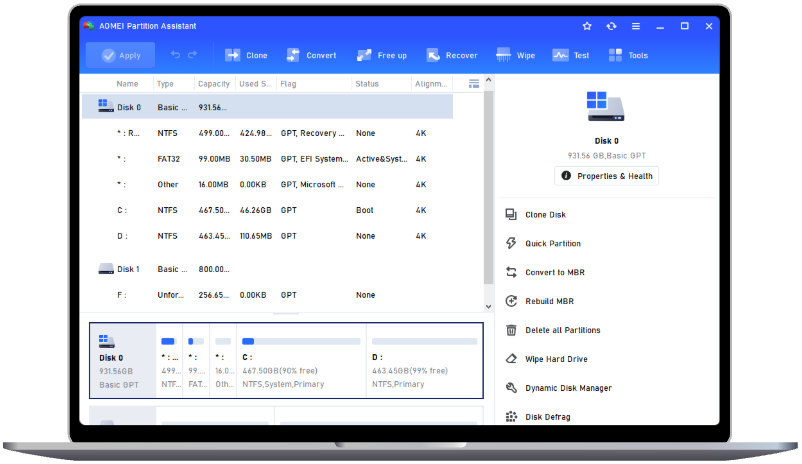
Step 1. Obtain AOMEI Partition Assistant and install it on your Windows PC. Open the software to see a clear overview of all your disks and partitions.
Step 2. Select the Target and Operation: Right-click the disk or partition you want to manage, and then choose the desired operation from the context menu (e.g., "Convert to GPT Disk," "Format Partition," or "Delete Partition").
Here is how to format a partition.
Step 1. Right-click the partition you want to format (Let's take F: partition for an example), and then select "Format Partition".
Step 3. The software will queue your operations. Click the "Apply" button in the top-left corner to execute the tasks.
Beyond fixing VDS errors, AOMEI Partition Assistant offers many other handy functions:
OS Migration: Seamlessly migrate your Windows installation to a new SSD or HDD.
Partition Recovery: Recover lost or deleted partitions.
Disk Cloning: Clone an entire hard drive to another for upgrades or backups.
Create Bootable Media: Build a WinPE bootable USB drive to manage partitions when your system won't start.
To Sum Up
The Virtual Disk Service is a crucial background process for managing Windows storage. When a "virtual disk service error" occurs, it can be a significant obstacle. By understanding the specific error message, you can often resolve the issue using built-in Windows tools. However, for a more reliable, feature-rich, and user-friendly experience that avoids these frustrations altogether, AOMEI Partition Assistant stands out as a superior alternative. It simplifies complex tasks, protects your data, and provides a powerful toolkit for any disk management scenario.