AOMEI Partition Assistant
What Is Virtual Disk Service and How to Use It?
what is virtual disk service, what is a virtual disk service, what is microsoft virtual disk service, what is the use of virtual disk service

By Lucas / Updated on November 28, 2025


In the complex ecosystem of a Windows operating system, numerous background services work tirelessly to ensure your computer runs smoothly. While users interact with graphical interfaces like File Explorer, deep in the architecture lies the machinery responsible for managing your hard drives, partitions, and volumes. One such critical component is the Virtual Disk Service (VDS). Despite its importance, few users understand what virtual disk service is or how it functions as the bridge between storage hardware and software.
This comprehensive article will demystify the technology behind Windows storage management. We will explore what Microsoft Virtual Disk Service is, explain its architecture, and guide you on how to effectively employ Virtual Disk Service using both native tools and a superior third-party alternative, AOMEI Partition Assistant Professional.
What Is Virtual Disk Service?
To effectively manage storage devices, Windows relies on a set of Application Programming Interfaces (APIs) known as VDS. But in layman's terms, what is a virtual disk service?
At its core, the Virtual Disk Service is a Microsoft Windows service that performs query and configuration operations at the request of end-users, scripts, and applications. It was introduced to provide a single interface for managing block storage virtualization, whether that storage is a simple hard drive inside a laptop or a complex Storage Area Network (SAN) in a server room.
When inquiring about what Microsoft Virtual Disk Service is, it is helpful to visualize it as a translator or intermediary. It sits between the storage management software (the Client) and the storage hardware (the Provider).
- The Client: Applications such as Disk Management, DiskPart, or third-party partitioning software.
- The Service: VDS itself, which coordinates activities.
- The Provider: Software components that communicate directly with the disk hardware.
So, what is the use of virtual disk service? Its primary use is to allow administrators and software to create partitions, format drives, assign drive letters, and configure RAID arrays without needing to know the specific commands for every different brand of hard drive or storage controller. It standardizes these operations, ensuring that a "Format" command works the same way regardless of the underlying hardware.
How to Employ Virtual Disk Service
While VDS runs in the background, users interact with it constantly through various "clients." Understanding how to employ these tools allows you to harness the power of VDS to organize your data and optimize your system.
Method 1: Using Native Windows Tools
For IT administrators and users running Windows 10/11 Pro or Enterprise, the most "native" way to handle this is through PowerShell. The Hyper-V management tools include specific commands to manipulate virtual disks.
Prerequisites: You must have the Hyper-V Management Tools installed (available on Pro/Enterprise/Education editions).
Step 1. Right-click the Start button and select "Windows PowerShell (Admin)" or "Terminal (Admin)".

Step 2. Ensure you know the exact file path of your .vhd or .vhdx file.
Step 3. Type the following command and press Enter:
Mount-VHD -Path "C:\Virtual Disks\MyWin10.vhdx"
Step 4. Once the command executes successfully, the VHD will be mounted. You can open File Explorer, and you should see the partitions of the VHD assigned as new drive letters. You can now copy, paste, and edit files.
Step 5. To remove the drive when finished, use the command:
Dismount-VHD -Path "C:\Virtual Disks\MyWin10.vhdx"
Note: This method relies on the Mount-VHD cmdlet, which is only available if the Hyper-V feature is enabled. If you are using Windows Home, this command will not work.
Method 2: A Universal Solution with AOMEI Partition Assistant Professional
While the PowerShell method is powerful, it has a significant drawback: it depends on Hyper-V components that are not available on standard Windows Home editions, and it requires memorizing command-line syntax. This is where AOMEI Partition Assistant Professional shines as a superior alternative. It democratizes virtual disk management, allowing you to mount VHD Hyper-V files on any Windows PC, regardless of the edition, through a user-friendly graphical interface.
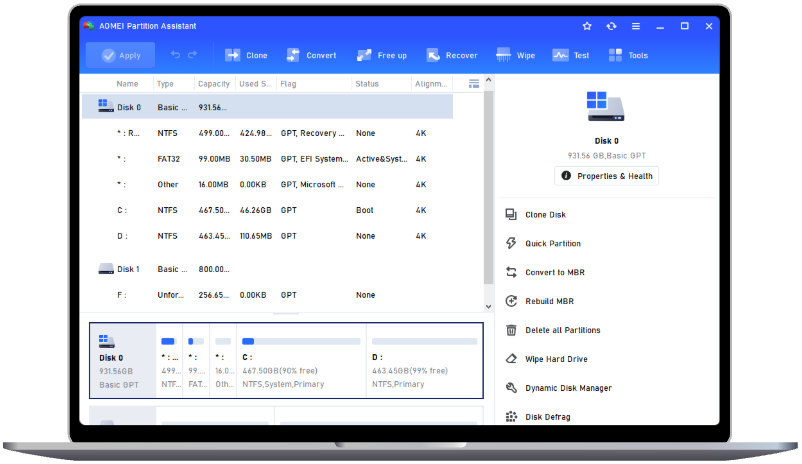
AOMEI Partition Assistant Professional is a comprehensive disk management toolkit. It has recently integrated robust Virtual Disk Management capabilities, allowing users to Create, Attach (Mount), and Detach virtual disks with just a few clicks. It bypasses the need for the Hyper-V feature to be enabled, making it the perfect tool for users who want to know how to mount VHD in Hyper-V formats without the complexity of system administration tools.
 100% Secure
Step 1. Download, install, and run AOMEI Partition Assistant Professional. Open Virtual Disk Management: Navigate to the "Tools" tab in the top menu bar and click on "Virtual Disk."
Step 2. In the pop-up window, click the "Attach" button. Specify the location of your VHD or VHDX file. Select it and confirm.
Step 3. The software will instantly mount the virtual disk. It will appear in the AOMEI main interface as a new disk, and simultaneously in your Windows File Explorer with an assigned drive letter. You can now manage it exactly like a physical USB drive.
Step 4. When you are done, simply return to the Virtual Disk Management window, select the disk, and click "Detach."
Why AOMEI is the Better Choice:
1. No OS Restrictions: Unlike the Mount-VHD command, AOMEI works on Windows 10/11 Home, Pro, and Enterprise equally well.
2. Visual Interface: No need to type paths or memorize commands.
3. Additional Features: AOMEI Partition Assistant offers a suite of other handy functions. You can clone the mounted VHD to a physical SSD to migrate your OS, convert the partition style from MBR to GPT, or recover lost partitions inside the virtual disk—tasks that standard Hyper-V tools cannot do easily.
To sum up
Accessing the data locked inside a virtual machine file doesn't require booting up the OS. The ability to perform a Hyper-V mount VHD operation directly to your host system saves time and resources. While Windows Pro users can utilize the PowerShell Mount-VHD command, this alienates the millions of users on Windows Home.
AOMEI Partition Assistant Professional bridges this gap, offering a seamless, graphical way to mount VHD Hyper-V files on any Windows computer. By choosing AOMEI, you gain not only a universal mounting tool but also a powerful disk manager capable of handling complex cloning and migration tasks.