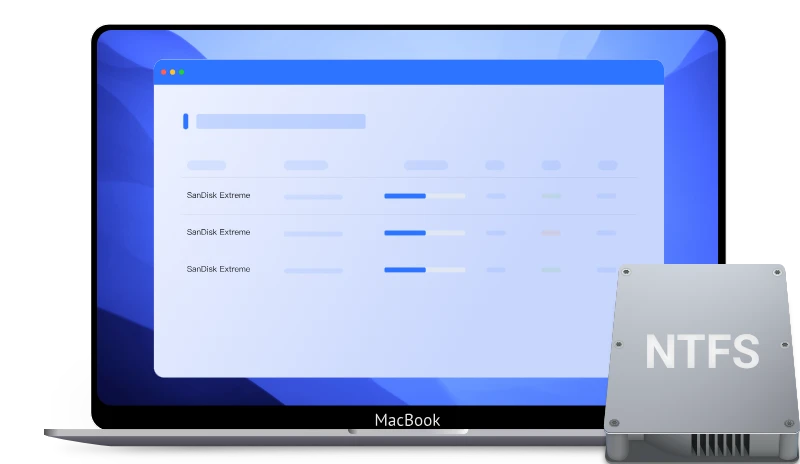
PartitionAssistant NTFS for Mac
Easy Guide: What Is NTFS for Mac?
Do I need NTFS for Mac? If you use Windows drives, the answer is yes. Discover how PartitionAssistant NTFS for Mac solves read-only issues on macOS 12+ and Apple Silicon M1/M2 chips safely and easily.

By Lucas / Updated on December 23, 2025


The boundary between operating systems is increasingly blurred. It is common for professionals, students, and creatives to switch between a Windows PC at work and a MacBook at home. However, this hybrid workflow often hits a snag when transferring data via external hard drives. You plug a drive into your Mac, and while you can open the files, you find yourself unable to edit them, delete them, or add new data.
This frustrating limitation is due to file system incompatibility. This article aims to demystify this technology. We will explore what NTFS for Mac is, explain why Apple places restrictions on Windows-formatted drives, and provide authoritative solutions to help you gain full control over your external storage devices.
What Is NTFS for Mac and Do I Need It?
To understand the solution, we must first analyze the problem. What is NTFS for Mac, and why does it exist as a specific software category?
NTFS (New Technology File System) is the proprietary file system developed by Microsoft. Since the days of Windows NT 3.1, it has been the standard format for Windows internal drives and most high-capacity external drives due to its reliability, journaling capabilities, and support for massive file sizes. On the other side of the fence, NTFS for Mac OS refers to the capability—usually added via third-party drivers—that allows a Mac computer to read and write to these Windows-formatted drives.
By default, Mac OS uses its own file systems (APFS or HFS+). When you connect an NTFS drive to a Mac, Apple’s operating system creates a "NTFS Read-Only" connection. This means you can view your data, but you cannot change it. If you strictly use Apple products and never share physical drives with Windows users, you might not need it. However, you definitely do need NTFS for Mac capabilities if:
You work in a hybrid environment
You frequently move files between a Windows PC and a Mac using a USB stick or external SSD.
You use high-capacity drives
Most external hard drives come pre-formatted as NTFS. Reformatting them to a Mac format (like APFS) makes them unusable on Windows.
You need to edit large files
If you are a video editor or photographer receiving drives from clients, they will likely be NTFS. You need write access to save your edits back to the same drive.
How to Enable Full NTFS Capabilities on Mac
Once you have determined that you need write access, the next step is implementation. There are two primary ways to achieve this: using a risky, hidden system command or utilizing professional software designed for seamless integration.
Method 1: Enabling Native Support via Terminal (Experimental)
Apple does include a hidden, experimental driver that can write to NTFS, but it is disabled by default because it is known to be unstable and can lead to data corruption.
Warning: This method involves modifying system configuration files. Proceed only if you are comfortable with command lines and have a backup of your data.
Step 1. Go to Applications > Utilities > Terminal.

Step 2. Type sudo nano /etc/fstab to open the file system table. Enter your admin password.
Step 3. Type LABEL=DRIVENAME none ntfs rw, auto, nobrowse (Replace "DRIVENAME" with the exact name of your drive).
Step 4. Press Ctrl+O to save and Ctrl+X to exit.
Step 5. Eject and re-plug the drive. It will not appear on the desktop; you must navigate to /Volumes in Finder to access it.
Method 2: The Professional Solution – PartitionAssistant NTFS for Mac
For a safe, reliable, and user-friendly experience, relying on professional software is the industry standard. PartitionAssistant NTFS for Mac is a cutting-edge utility designed to solve the NTFS for Mac OS compatibility issue instantly.
PartitionAssistant NTFS for Mac is a lightweight yet powerful tool that mounts NTFS drives in "Read-Write" mode automatically. It eliminates the need for complex Terminal commands and ensures data integrity.
This software is designed for the modern Mac user:
Broad Compatibility: It supports a vast array of storage media, including HDDs, SSDs, USB flash drives, SD cards, and CF cards.
File System Versatility: Beyond standard NTFS (supporting versions from Windows NT 3.1 all the way to Windows 11), it also provides excellent management for FAT32 and exFAT file systems.
Modern OS Support: It is fully optimized for macOS 12 and later. Crucially, it runs natively on both Intel-based Macs and the newer Apple Silicon (M1/M2) Macs.
 100% Secure
Note: Don't forget to configure the Security Policy in iOS Recovery Mode. macOS can only read NTFS partitions by default, not write directly to them. To write data to an NTFS partition on macOS, you need to use a third-party NTFS driver. These drivers are kernel extensions (Kexts), so macOS needs to reduce its system security policies to allow loading kernel extensions from identified developers.
Step 1. Run PartitionAssistant NTFS for Mac and connect your NTFS hard drive or USB flash drive.
Step 2. The connected, removable, and external USB drives will be mounted and listed.
Step 3. Select the drive you want to operate and click "Open".
Step 4. Now you can copy files on your Mac and click "Paste Item" to copy the files to the USB drive.
Step 5. You can also copy, delete, and rename files on the external hard drive.
Step 6. After all operations are complete, please click "Eject" to disconnect the external hard drive from your Mac.
To sum up
The question of what NTFS for Mac is unveils a significant gap in cross-platform compatibility. While macOS can read Windows drives, the inability to write to them impedes productivity for anyone working with both operating systems. While adventurous users might explore "free" methods via Terminal commands, the risk of data corruption makes this an unwise choice for important files.
Instead, utilizing a dedicated tool like PartitionAssistant NTFS for Mac is the authoritative recommendation. By providing full read-write access, supporting the latest Apple Silicon hardware, and ensuring safe ejection protocols, it transforms a compatibility headache into a smooth experience. Whether you are dealing with NTFS for Mac OS on a legacy Intel machine or a new M2 MacBook, this software ensures your data flows freely.
FAQs
Q1: Is NTFS for Mac software necessary for everyone?
A: Not necessarily. If you only use Apple computers and never share drives with Windows users, you can format your drives to APFS. However, if you need to transfer files between Mac and PC using the same hard drive, you definitely do i need NTFS for Mac software to edit files on the Mac side.
Q2: Can I just format my drive to exFAT to avoid using NTFS for Mac?
A: Yes, exFAT is readable and writable by both Mac and Windows. However, NTFS is generally more robust and reliable for data integrity (journaling) than exFAT. If you are sharing drives that are already full of data, reformatting to exFAT will erase everything, making PartitionAssistant NTFS for Mac a better non-destructive solution.
Q3: Is it safe to use third-party NTFS drivers on Mac?
A: Yes, provided you use reputable professional software like PartitionAssistant. Unlike experimental Terminal hacks, which can cause data corruption, professional tools use stable drivers designed to protect data integrity during transfer.
Q4: Why can't Apple just include NTFS write support natively?
A: Apple includes read support but disables write support primarily due to licensing issues with Microsoft (NTFS is proprietary) and stability concerns. Apple prefers users to use its own file system, APFS.