AOMEI Partition Assistant
2 Ways to Recover Lost Partition in Windows 10, 8, 7, And 11
Do you want to know how to recover lost partition in Windows 10 effectively and safely? You are going to learn to do it in two ways from here, both these ways are also suitable for other Windows systems.

By AOMEI / Updated on June 30, 2026


A lost partition in Windows 10 can occur after accidental deletion, corrupted partition tables, failed updates, virus attacks, or improper disk operations. When this happens, the partition may appear as “Unallocated” in Disk Management, and the stored files become inaccessible.
Here are the most effective ways to recover a lost partition in Windows 10.
|
Method 1. Recover a lost partition using CMD |
Use CMD and DiskPart commands to reassign a drive letter, making a hidden or lost partition visible again. |
|
Method 2. Perform partition recovery in an easier way |
Use AOMEI Partition Assistant to quickly recover deleted or lost partitions through a simple step-by-step recovery wizard. |
“Oops! I’ve accidentally lost my partition!”
Generally, you should partition a storage device into one or more partitions before you use it to store data. A partition can be created either during Windows installation, in Disk Management, by using the DiskPart command, or through a specialist third-party tool. However, sometimes you might find your partition is lost, and you are unable to see it in Windows File Explorer. In Disk Management, the lost partition will appear as extra unallocated space rather than the original partition.
"I have a Windows 10 computer and I have made a big mistake! I have a hard drive that stores all my media files, but I accidentally deleted the volume and all files are gone! It now shows “Unallocated”! Is there any way to recover the deleted volume on Windows 10 and get back my files?”
As the example shows, Once a partition gets lost, deleted, or corrupted, all files in that partition are likely to be lost at the same time. In this case, you have to perform disk partition loss recovery in Windows 10 and then your files will be restored.
Tips: If you want to avoid further data loss before lost partition recovery, you should pay attention to the following things:
▸ Do not perform any operation on the hard drive.
▸ Do not reformat the hard drive.
▸ Do not add new items to the partition.
▸ Do not rebuild the partition table.
Is it possible to recover deleted volume in Windows 10?
The majority of users think the partition has gone forever after deleting or cleaning. But you still wonder if it is possible to recover deleted volume in Windows 10 because you cannot afford data loss owing to partition loss.
Fortunately, you can recover deleted partition using a professional partition recovery tool, because your computer recognizes a partition by its partition table and boot sector. When you delete a partition on the computer, the system just removes partition information (eg: partition type, size, location, file system, etc.) from the partition table rather than wiping the area occupied by the deleted volume completely. At last, you just cannot see that partition in Disk Management or File Explorer.
How do I recover lost partition in Windows 10?
As mentioned above, partition loss can be caused due to a variety of different reasons. You can try the following methods - hopefully, one will work for you!
▶ Method 1. Recover a lost partition using CMD
If you want to know how to recover deleted partition using CMD, you can refer to the following part. Sometimes a lost volume label, drive letter or partition name can cause a partition to disappear. When you think this is happening, you can try this method to assign a drive letter to it and make it visible again in File Explorer.
Step 1. Open CMD and run as administrator.
Step 2. Type diskpart in the window and press Enter.
Step 3. Type the following commands one after the other, ending with the Enter key each time.
● list disk
● select disk 2 (Replace # with the number of the hard drive that contains the lost partition.)
● list volume
● select volume 4 (Replace # with the number of the lost partitions)
● assign letter=g (Replace # with an available drive letter).
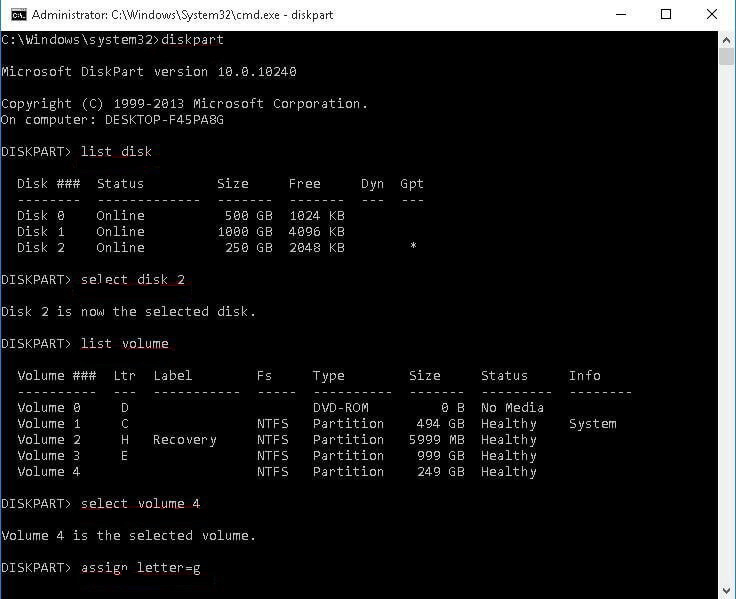
Step 4. Exit this window and see if you can access that partition.
▶ Method 2. Perform partition recovery in an easier way
If the partition is deleted and then gets lost, you can use a professional recovery program like AOMEI Partition Assistant Professional to recover the missing partition. It is one of the market-leading partition recovery products. It is designed to recover lost partitions in Windows 11, 10, 8, 7, Vista, and XP with an easy step-by-step process that anyone can follow. To recover lost partition in Windows Server 2022, 2019, 2016, 2012, and more, please use AOMEI Partition Assistant Server.
❤❤❤❤❤
AOMEI Partition Assistant Professional is a versatile partition manager, with which you can easily manage your disk partition. It not only has the basic functions that Disk Management offers like “create partitions, delete partitions, format partitions, change drive letter, shrink partition, extend partition”, but also has many advanced features such as “convert MBR and GPT without deleting partitions, move partition, clone partition, merge partition, format large hard drive (over 32GB) to FAT32, allocate free space from one partition to another, clone hard disk, data recovery, etc.”.
To recover deleted volume in Windows 10 or 11 via AOMEI Partition Assistant Professional, please follow the steps detailed below.
Step 1. Find the lost partition in Disk Management. Install and open AOMEI Partition Assistant Professional.
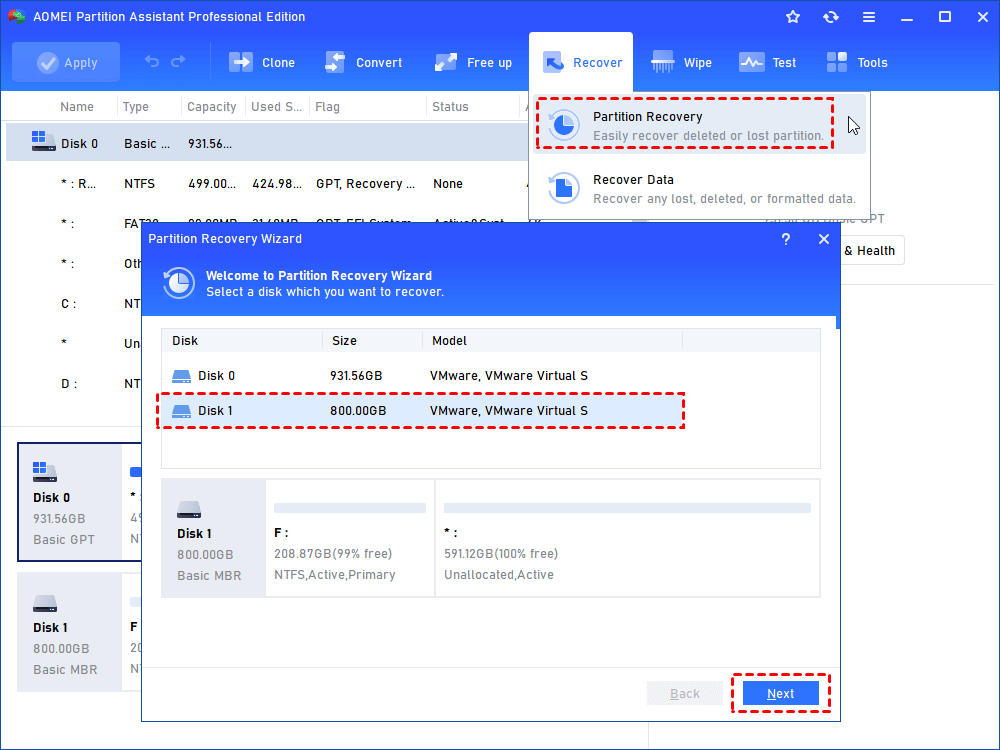
Step 2. Go to Recover > Partition Recovery on the main interface. When you get into the partition recovery wizard, select a disk that you want to recover. Click Next.
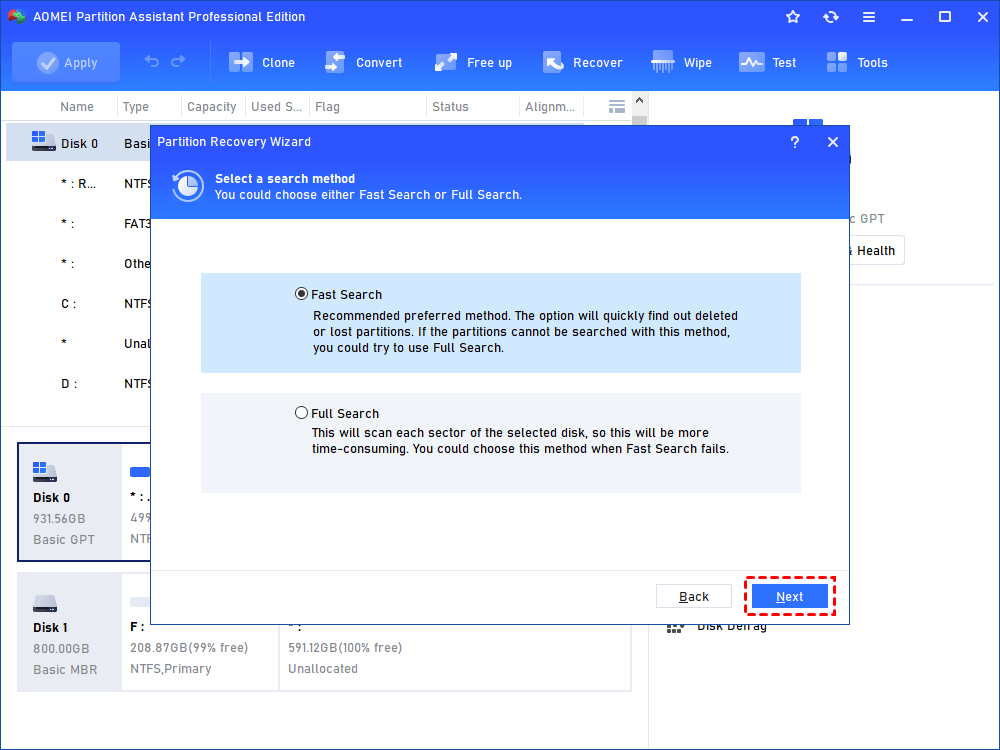
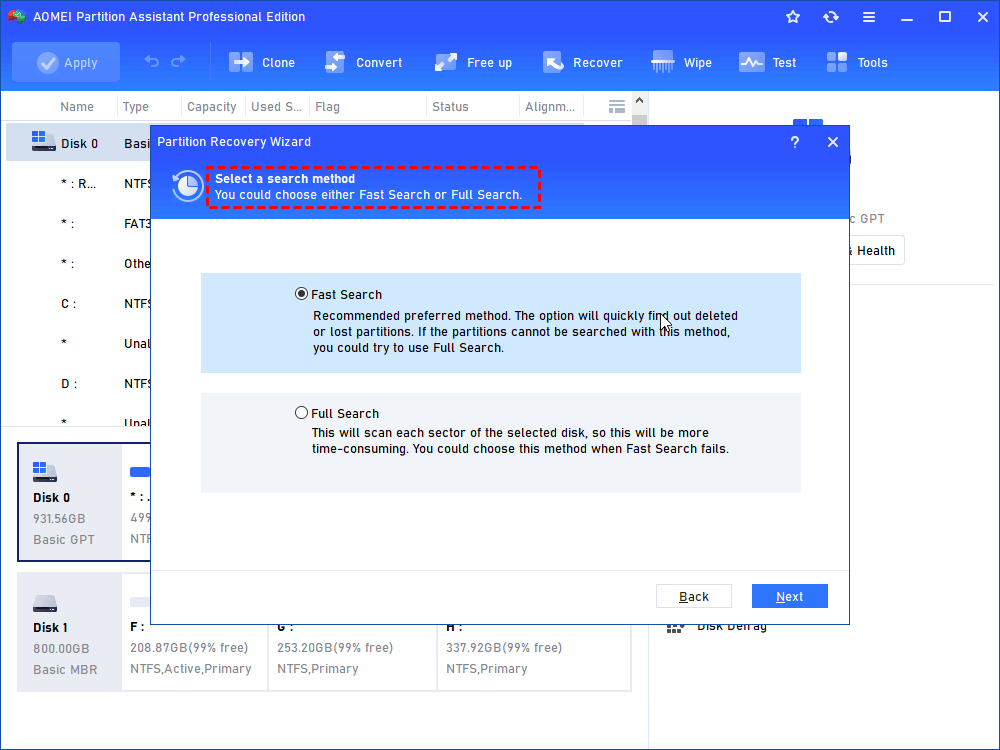
Step 3. Select Fast Search. It is recommended that you select this option the first time as it is faster than Full Search. If you are unable to recover the lost partition using Fast Search then I recommend you try the Full Search option.
Step 4. Select the lost partition and click Proceed.

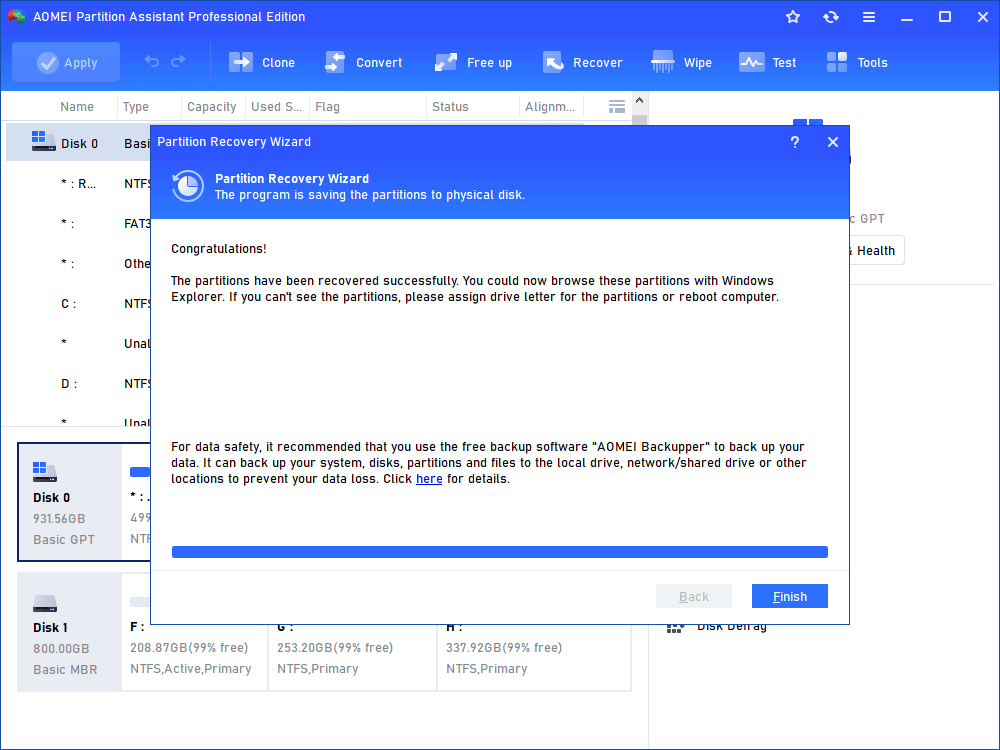
Step 5. Click Finish to exit this window after you see the congratulations message.
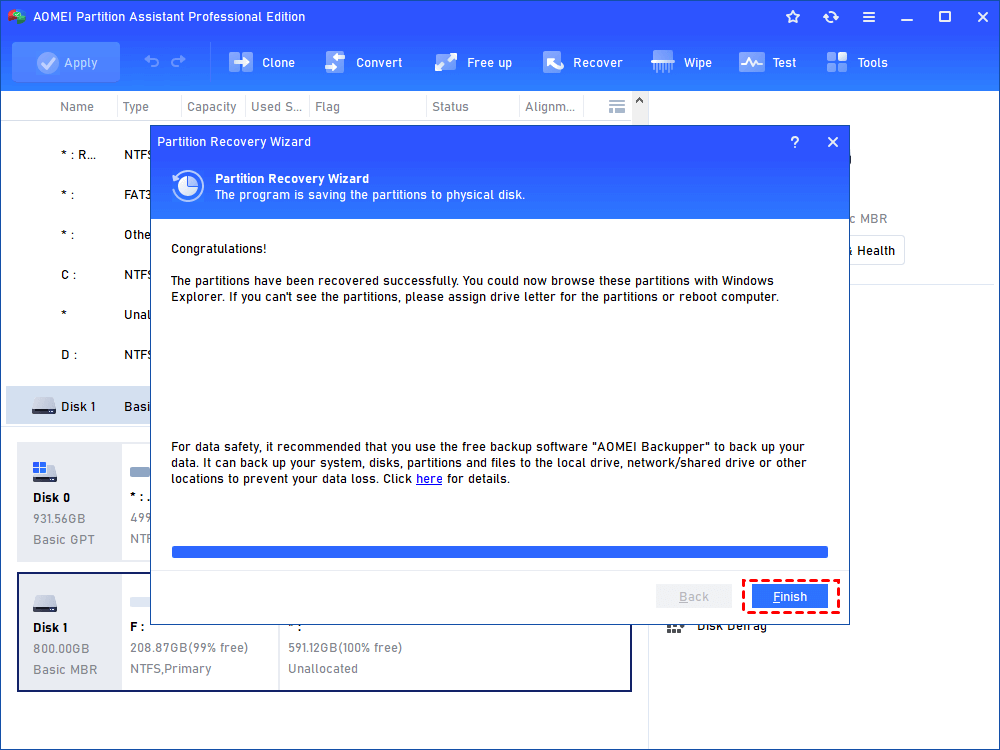
Then you can go to Windows File Explorer to check if the partition is restored. If you did not make any further operations on the partition since it is deleted and lost, the inside data will also be back and accessible now.
Why does a partition get lost in Windows 10?
A partition can get lost in Windows 10 for several reasons, ranging from accidental mistakes to hardware or system problems. Here are the most common causes:
◆ Accidental deletion: A partition missing may be mistakenly deleted during disk management. And sometimes the data-protection software McAfee will delete your files.
Windows installation, or partition resizing.
◆ Partition table corruption: Damage to the MBR (Master Boot Record) or GPT partition table can make partitions disappear or become inaccessible.
◆ Virus or malware attacks: Malicious software can corrupt partition information or hide partitions from File Explorer.
◆ Power failure or improper shutdown: Sudden power loss during disk operations may damage the file system or partition structure.
◆ Bad sectors or hard drive failure: Physical disk damage can cause Windows to lose access to partitions.
◆ Drive letter conflicts: Sometimes the partition still exists, but Windows does not assign a drive letter, making it invisible.
◆ Incorrect disk conversion: Converting disks between MBR and GPT, or basic and dynamic disks, may lead to partition loss if interrupted.
What to do if you accidentally delete boot partition in Windows 10?
If you accidentally delete the boot partition in Windows 10, the computer may fail to start and display errors such as “Operating System Not Found”, “Bootmgr is Missing”, or a black screen during startup. The good news is that the boot partition can often be recovered or rebuilt.
If the partition was recently deleted and no new data has overwritten the disk space, you can use a partition recovery tool such as AOMEI Partition Assistant to scan the disk and restore the deleted partition.
Note: AOMEI Partition Assistant can also help recover missing lots of hard drive space after cloning.
Step 1. Connect an empty USB drive to the working Windows computer, and install and launch AOMEI Partition Assistant Professional on this PC as well. Click "Tools" > “Make Bootable Media” on the upper toolbar and “Next” on the next screen.
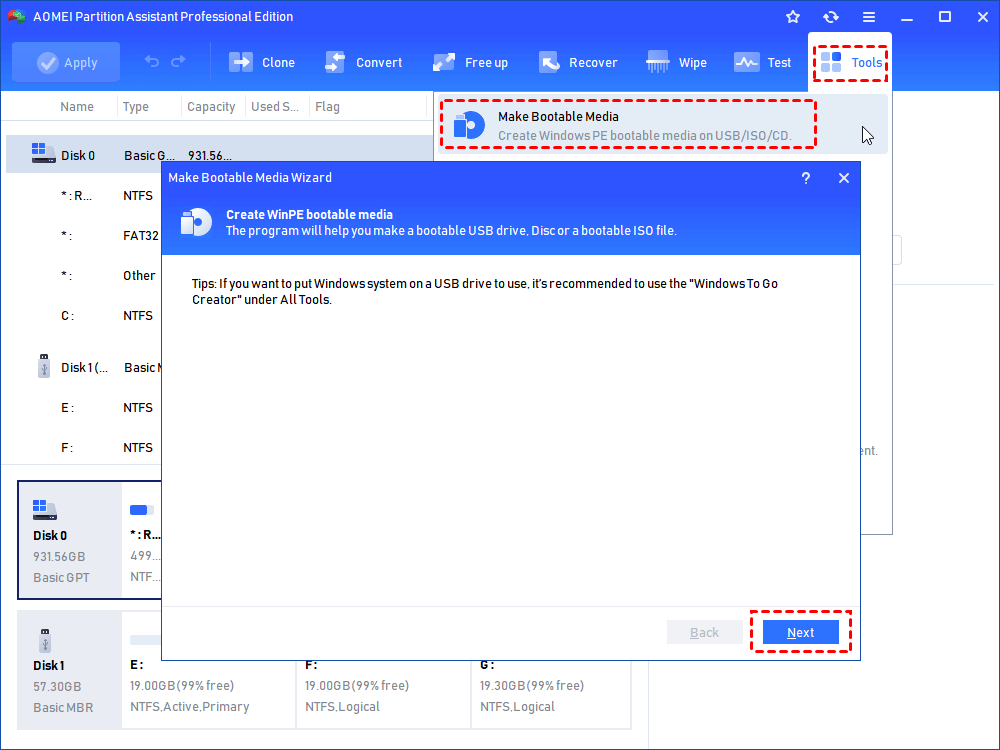
Step 2. Tick “USB Boot Device” in the following window and click “Proceed” to start the pending operation.
Step 3. After the bootable USB drive is created successfully, you can insert it into the Windows computer, and change the boot order to boot the computer from the destination bootable drive.
Step 4. Click "Recover" > ”Partition Recovery" on the main interface.
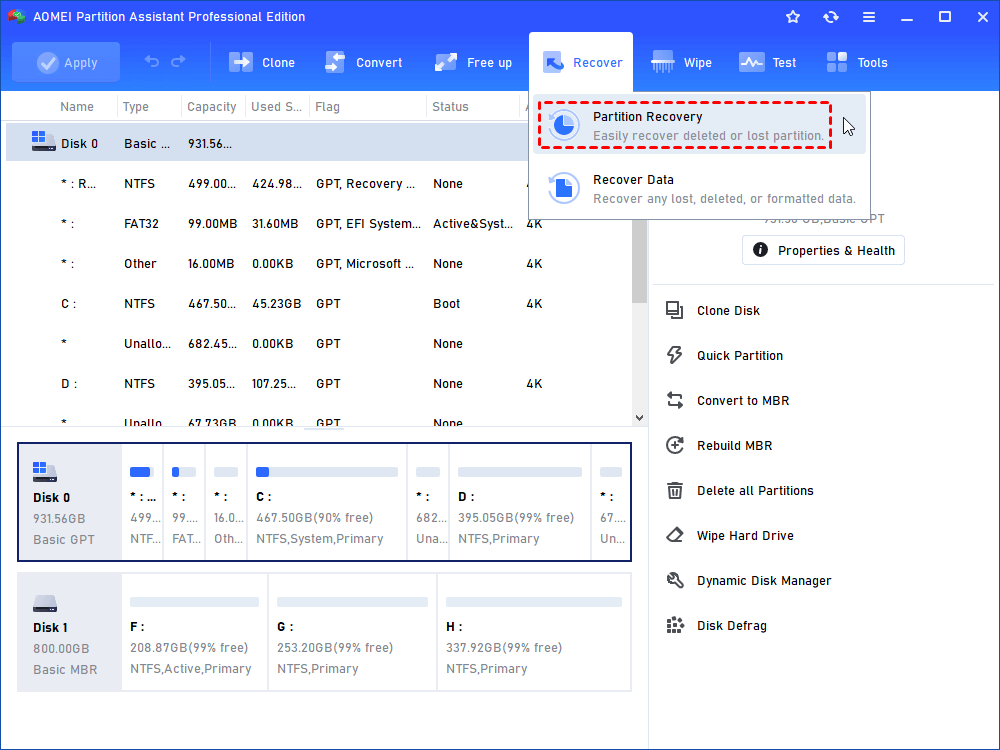
Step 5. Select the disk which contains deleted boot partition.
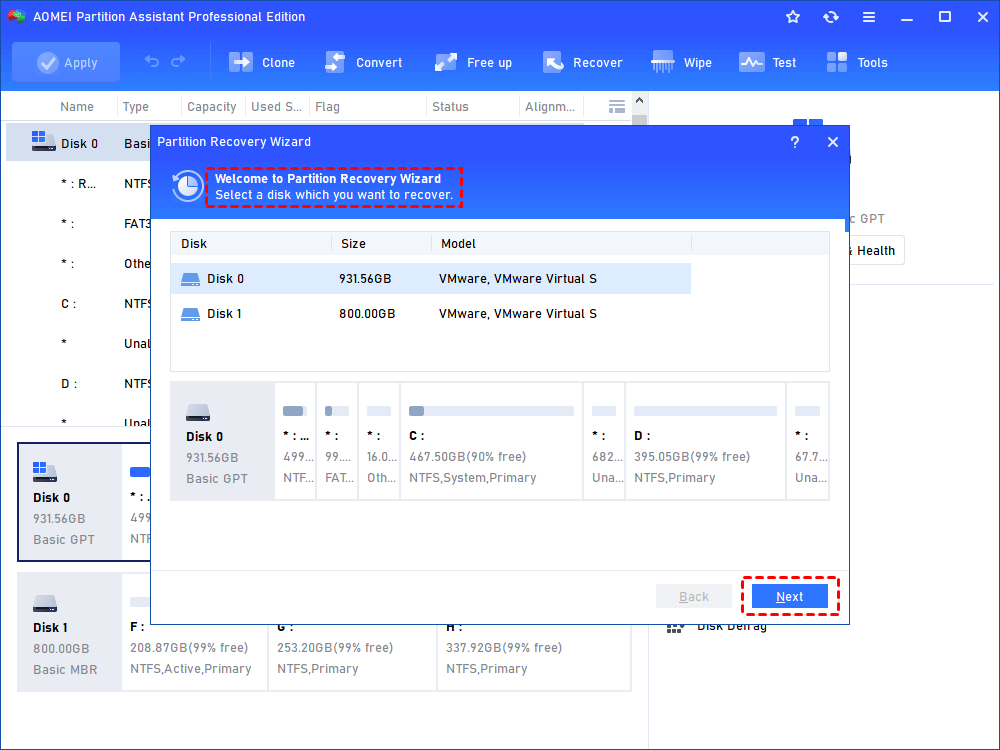
Step 6. Select “Fast Search” for the first time and click “Next”. This method takes less time. If you cannot find the deleted partition, you can select “Full Search” later.
Step 7. Select the deleted boot partition in the following list and click “Proceed”. For security, you can click “Explore files in the selected partition” and view files to confirm.
FAQs
1. Can I recover a deleted partition in Windows 10?
Yes. If the partition data has not been overwritten, recovery software can often restore the deleted partition and its files.
2. Why does my partition show as unallocated space?
Unallocated space usually indicates that the partition table entry is missing, deleted, or corrupted, even though the data may still exist.
3. Is it safe to use CMD for partition recovery?
CMD tools such as DiskPart can safely restore drive letters, but incorrect commands may cause additional problems. Double-check every command before execution.
4. Can SSD partitions be recovered?
Yes. SSD partitions can often be recovered, although recovery success may depend on factors such as TRIM functionality and how much new data has been written.
5. What is the first thing I should do after losing a partition?
Stop using the affected drive immediately and avoid creating new partitions or saving new files. This helps preserve recoverable data and maximizes recovery success.
The way forward
In most circumstances, you can recover lost partition in Windows 10 or 11. But you should make sure you fully understand the reasons why the partition was lost to avoid it happening again in the future. If you have followed all the above steps and you still can’t use the files in your partition, then you should check for bad sectors. You can do this via the Check Partition function in AOMEI Partition Assistant.
I always suggest that you create a backup image for your partition in case anything happens. Once something goes wrong it's far easier to restore your computer to its previous state with a system image.