AOMEI Partition Assistant
VHD Formatter: How to Create and Format Virtual Disks Effectively
Discover how to format a VHD and manage virtual disks effectively. Our guide covers VHD format types and professional tools to completely format VHD partitions.

By Lucas / Updated on January 13, 2026


Virtual Hard Disks (VHDs) have become an essential component of modern computing, allowing users to create isolated storage environments for testing software, running multiple operating systems, or managing backups. However, managing these virtual containers often requires a specialized VHD formatter to ensure they function correctly within Windows.
Whether you are dealing with a corrupted virtual drive or simply need to change the file system for a specific project, knowing how to format VHD volumes properly is crucial. This guide will explore the best methods to manage your virtual storage, from built-in Windows tools to professional third-party management software.
Understanding VHD and Why You Need to Format It
A Virtual Hard Disk is essentially a file that acts like a physical hard drive, containing its own partitions and file systems. Understanding the VHD format is the first step toward effective disk management, as these files can be easily moved between physical hosts.
There are several reasons why a user might need to completely format VHD files. Over time, virtual disks can accumulate "ghost" data, or the file system may become RAW, making it inaccessible to the host OS. Additionally, you might need to change the partition style from MBR to GPT or switch the file system from NTFS to FAT32 to meet specific software requirements. In these cases, a reliable formatting process ensures the virtual environment remains stable and efficient.
How to Format a VHD Using Windows Disk Management
Windows provides a native utility called Disk Management that can perform basic virtual disk operations. This method is the standard way to address how to format a VHD without downloading additional software, though it has some limitations regarding file system flexibility.
Step 1. Attach the VHD: Right-click the Start button and select Disk Management. Click Action in the top menu and select Attach VHD. Browse to your VHD or VHD file and click OK.
Step 2. Initialize the Disk: If the disk is new or unallocated, right-click the disk number (e.g., Disk 2) and select Initialize Disk. Choose between MBR and GPT.

Step 3. Create and Format: Right-click the unallocated space and select New Simple Volume. Follow the wizard, and when you reach the "Format Partition" screen, choose your desired file system (NTFS or FAT32) and click Finish. This will format VHD space for immediate use.
Using AOMEI Partition Assistant as a Professional VHD Formatter
While Windows tools are functional, they often lack advanced features like resizing virtual partitions without data loss or converting file systems efficiently. AOMEI Partition Assistant serves as a powerful, all-in-one VHD formatter and disk manager that simplifies complex virtual disk tasks.
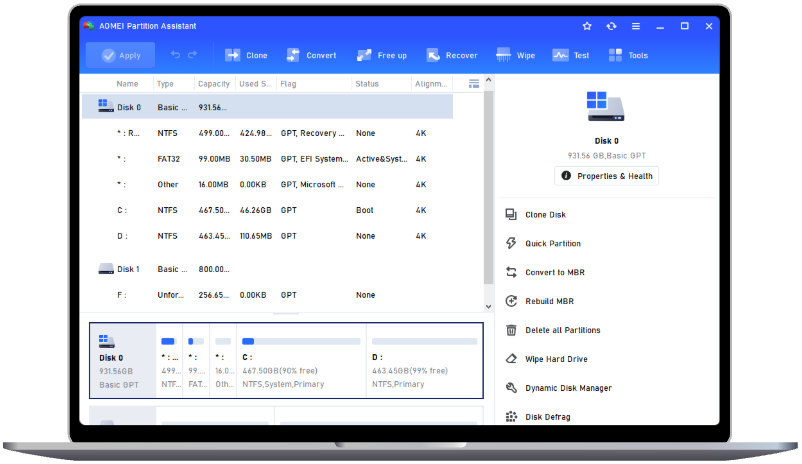
AOMEI Partition Assistant is a renowned Windows computer management software designed to optimize disk performance. Its dedicated "Virtual Disk" management capabilities allow users to treat VHDs with the same flexibility as physical drives. As a professional-grade tool, it offers a more intuitive interface than Disk Management, making it easier to completely format VHD volumes even if they appear as "RAW" or "Unformatted" in other tools.
 100% Secure
To format VHD, you may have 2 scenarios.
1. Format VHD When You Create
When you create a VHD, you’ll be asked to choose a format. Here, we’ll show how to use AOMEI Partition Assistant to create VHD and format it.
Step 1. Download and install AOMEI Partition Assistant on a Windows computer. Click the tab "Virtual Disk", you will see 3 options available for VHDs: create VHD, attach VHD, and detach VHD.
Step 2. Select the "Create VHD" option after clicking the "Virtual Disk" tab.
Step 3. You can specify the virtual disk location and size. Optionally, you can click the "Advanced" option to set the virtual hard disk format and type. (By default, the VHDX format and the Dynamically expanding type are checked.)
- For VHD, it supports virtual disks up to 2040GB in size.
- For VHDX, it supports virtual disks larger than 2040GB in size. (Up to 64TB) This format is not supported in operating systems earlier than Windows 8 or Windows Server 2012.
Step 4. Click "Browse" to select a location to create the VHD. Please enter a file name for the virtual disk and click "Save".
Step 5. Once the virtual disk location and size are set up, you can click "OK" to start creating the VHD.
After the reload process is finished, you will see that the VHD has been created successfully. It will be attached automatically.
2. Format File System on Your VHD
After you created a VHD, you need to initialize the VHD, and format file system. In AOMEI Partition Assistant, you can choose “Format Partition”.
Step 1. Right-click a partition on the disk you want to format and select “Format Partition”.
Step 2. Set the partition label, cluster size and file system as you like, and click “OK”.
Step 3. Begin to format the hard disk by clicking “Apply” in the main interface.
Troubleshooting Common VHD Format Issues
Even with a good VHD formatter, users may encounter errors such as "The disk is write-protected" or "Windows was unable to complete the format." These issues often stem from the VHD being mounted as "Read-Only" or the host file system having permission conflicts.
To fix these issues, ensure that the folder containing the VHD file has full read/write permissions for your user account. If the VHD format process fails in Disk Management, using a third-party tool like AOMEI Partition Assistant can often bypass these logical locks, as it uses more advanced formatting algorithms to overwrite the partition table and restore the drive to a healthy state.
Ending
Managing virtual storage doesn't have to be complicated if you have the right tools. Whether you use the built-in Windows Disk Management to learn how to format a VHD or opt for the advanced capabilities of AOMEI Partition Assistant Standard, ensuring a clean VHD format is essential for data integrity. By utilizing a dedicated VHD formatter, you can easily resize, convert, and maintain your virtual disks for any professional or personal project.
FAQs
1. What is the difference between VHD and VHDX format?
VHD is the older format with a 2TB limit, while VHDX is the modern version that supports up to 64TB and has better resilience against power failures. Most VHD formatter tools, including AOMEI Partition Assistant, support both types.
2. Can I format a VHD to FAT32 if it's larger than 32GB?
Windows Disk Management usually restricts FAT32 formatting to partitions under 32GB. However, using a professional tool like AOMEI Partition Assistant, you can format VHD partitions to FAT32 even if they are much larger.
3. Does formatting a VHD delete the files on my physical hard drive?
No. When you format VHD, you are only erasing the data inside the virtual disk file. The file itself remains on your physical drive, but its internal contents are wiped.
4. Why is my VHD showing as "Read Only"?
This often happens if the VHD file is stored on a read-only medium (like a finalized DVD) or if the "Read-Only" attribute was set when the disk was attached. You can change this in Disk Management by right-clicking the disk and selecting "Online" or checking the properties of the .VHD file.
5. How do I completely format VHD to start fresh?
To completely format VHD volumes, it is best to delete the existing partition within AOMEI Partition Assistant and create a new one. This ensures that all old partition table data is wiped and replaced with a clean file system.