AOMEI Partition Assistant
How to Fix All Groups Missing from The Local Users And Groups
Easily fix the missing Local Users and Groups snap-in. Our guide covers solutions for all Windows versions, including a powerful management tool for Windows Home users to create, delete, and manage accounts with ease.

By Lucas / Updated on October 14, 2025


Managing user accounts is a fundamental task for any Windows administrator or power user. The "Local Users and Groups" snap-in (lusrmgr.msc) is the go-to tool for creating new users, managing passwords, and assigning users to specific groups. However, it can be incredibly frustrating when you open Computer Management only to find that the entire local users and groups group missing, or worse, the snap-in is present but shows no users or groups.
This common problem can halt your administrative tasks in their tracks. Fortunately, this guide is here to help. We'll explore the reasons behind this issue and provide you with clear, step-by-step solutions to restore your ability to manage accounts effectively on your Windows PC.
Why are all groups missing from the local users and groups?
Understanding the root cause is the first step toward finding the right solution. When you discover all groups missing from the local users and groups, it's typically due to one of a few specific reasons.
You're Using Windows Home Edition: This is the most frequent reason. Microsoft does not include the Local Users and Groups (lusrmgr.msc) snap-in with any Home editions of Windows (e.g., Windows 11 Home, Windows 10 Home). This feature is reserved for Pro, Enterprise, and Education editions. If you have a Home edition, the tool is not missing due to an error; it was never included.
Corrupted System Files: Critical Windows system files can become corrupted due to malware, improper shutdowns, or software conflicts. If the files related to the Microsoft Management Console (MMC) or the lusrmgr.msc snap-in itself is damaged, it may fail to load properly or display any information.
MMC Snap-in Configuration Issues: The Microsoft Management Console (MMC) is the framework that hosts administrative tools like Local Users and Groups. If the console's configuration is broken or the snap-in has been manually removed from the view, it will appear to be missing.
Group Policy Restrictions: In a corporate or managed environment, a system administrator may have set a Group Policy to restrict access to Local Users and Groups for security reasons. This is less common on personal computers but is a possibility.
How to Solve all groups missing from the local users and groups
Don't worry, there are several effective methods to restore this functionality or work around the issue. Let's walk through the solutions, from the simplest checks to more advanced repairs.
Solution 1: Verify Your Windows Edition
Before attempting any complex fixes, it's crucial to confirm which version of Windows you are running. This quick check will tell you if the tool is supposed to be there at all.
Step 1. Press the Windows key + R to open the Run dialog box.
Step 2. Type winver and press Enter.

A window will appear displaying your Windows edition. If it says "Windows 10 Home" or "Windows 11 Home," then the computer management local users and groups missing is expected behavior. You can proceed to the command-line methods or our recommended third-party tool.
Solution 2: Manage Accounts via Command Prompt or PowerShell
Even if the graphical interface is unavailable, you can still manage all users and groups using powerful command-line tools. This is the primary workaround for Windows Home users.
This method allows you to perform most of the same tasks, such as creating users, changing passwords, and adding users to groups.
- To view all local users: Open Command Prompt as an administrator and type net user.
- To view all local groups: Type net localgroup.
- To add a new user: Type net user /add.
- To add a user to a group (e.g., Administrators): Type net localgroup Administrators /add.
Solution 3: Repair System Files with SFC and DISM
If you have a Pro or Enterprise edition of Windows and suspect file corruption is why all groups are missing from the local users and groups, you can use built-in Windows tools to scan for and repair issues.
These commands will check the integrity of your system files and restore any corrupted ones from a cached or online source.
Step 1. Type "Command Prompt" or "cmd" in the Windows search bar.
Step 2. Right-click on the result and select Run as administrator.
First, run the System File Checker (SFC) by typing the following command and pressing Enter:
sfc /scannow
After the SFC scan is complete, run the Deployment Image Servicing and Management (DISM) tool. Type the following commands, pressing Enter after each one:
DISM /Online /Cleanup-Image /CheckHealth
DISM /Online /Cleanup-Image /ScanHealth
DISM /Online /Cleanup-Image /RestoreHealth
Once finished, restart your computer and check if Local Users and Groups is restored.
Windows Home local users and groups management tool
For Windows Home users, or for those who simply prefer a more user-friendly and powerful graphical interface, the command line isn't the only option. A third-party utility can provide the functionality you're missing and much more.
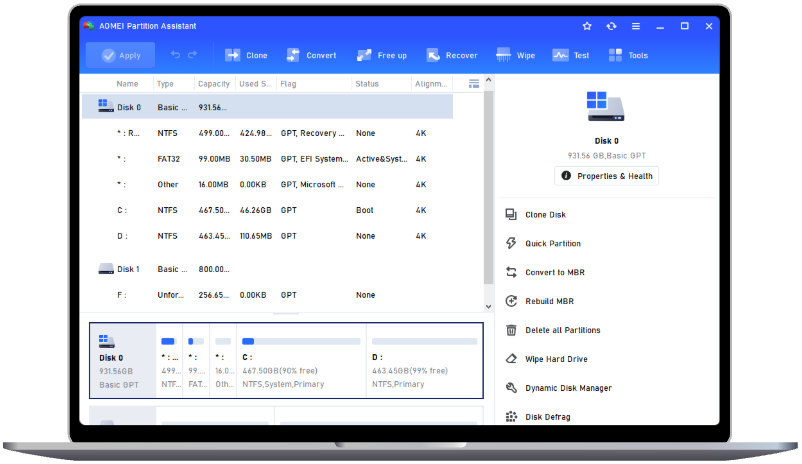
We recommend AOMEI Partition Assistant Professional as a comprehensive solution. While renowned for its powerful disk and partition management features, this versatile software has recently introduced a new function to Create and Manage Local Users and Groups. This makes it the perfect tool for users whose computer management local users and groups missing problem is due to running Windows Home. It brings the ease of a graphical interface for user management to all Windows editions.
 100% Secure
How to Manage Users and Groups with AOMEI Partition Assistant
Download, install, and launch AOMEI Partition Assistant Professional. On the main interface, click "Tools" in the top menu and select the "Windows Tools" option. In the new window, navigate to the "Users & Groups" section in the left-hand pane. This will display all existing user accounts and groups on your system in a clean, organized list.
From here, you can easily perform all necessary administrative tasks. You will see intuitive buttons to:
Create User: Set a new username and password.
Delete User: Remove an existing account.
Edit User Properties: Change a user's password or other details.
Manage Group Membership: Add a user to a group (like Administrators or Remote Desktop Users) or remove them with just a few clicks.
Beyond this excellent new feature, AOMEI Partition Assistant Professional is a powerhouse for PC management, offering other handy functions like:
Migrate OS to SSD/HDD: Move your Windows installation to a new drive without reinstalling.
Disk Clone Wizard: Create an exact copy of your hard drive for backup or upgrade purposes.
Partition Recovery Wizard: Recover lost or deleted partitions.
App Mover: Move installed programs from one drive to another to free up space.
To Sum Up
Facing a situation where all groups missing from the local users and groups can be a significant roadblock, but it's almost always solvable. The key is to first identify the cause—most commonly, you're using a Windows Home edition that doesn't include the feature.
For those on Pro editions, system file corruption is a likely culprit, which can be fixed with SFC and DISM scans. For Windows Home users, the command line offers a built-in workaround. However, for the most seamless and feature-rich experience across all Windows versions, a dedicated tool like AOMEI Partition Assistant Professional provides an intuitive and powerful alternative, restoring easy graphical management of all your user accounts and offering a wealth of other PC maintenance tools.