AOMEI Partition Assistant
SSD Not Showing Full Capacity After Clone? Fix It Now!
Have you ever encountered an SSD not showing its full capacity after cloning? Don’t worry—this guide will help you reclaim the missing storage space and ensure your SSD operates at its full potential.

By Gia / Updated on May 7, 2025


Why is My SSD Not Showing Full Capacity?
When upgrading or replacing drives, you may find your cloned SSD not showing full capacity. For example, you want to upgrade your drive to an SSD with 1TB capacity. After cloning, you notice that the cloned SSD is only showing about 500GB of usable space. Why does it happen? Here are several common reasons:
Cloning Process Issues (Most Common):
The cloning process replicates the exact partition structure of the source drive onto the target SSD. However, the extra space on the target drive, which exceeds the size of the original drive, may remain unallocated. This unallocated space will be invisible in Windows File Explorer.
SSD Formatting Issues
If the SSD is formatted improperly or uses a file system that isn't configured to handle the full capacity, it could limit the usable space. For example, an unformatted partition will show as unallocated space.
BIOS/UEFI Settings
Sometimes, improper BIOS or UEFI settings can prevent the SSD from being recognized correctly, especially in the case of NVMe SSDs. If the SSD is not fully detected by the BIOS, the full capacity won’t be available to the system.
3 Ways to Fix SSD Not Showing Full Capacity After Clone
Now, let’s go through several reliable methods to fix the issue of an SSD not showing its full capacity after cloning. These methods will help you reclaim the missing storage space and ensure your SSD works as expected.
Method 1. Extend Partition with Unallocated Space
If your SSD shows unallocated space, you can extend the existing partition to use this space. This situation commonly occurs when the cloned partition doesn’t automatically scale to match the size of the new SSD. Extending the partition allows you to utilize the full storage capacity without having to re-clone the drive or risk data loss.
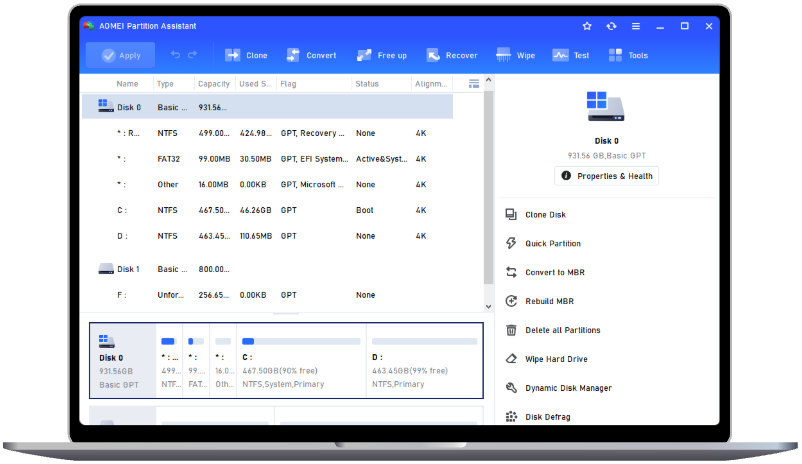
To do this effectively, we recommend using AOMEI Partition Assistant — a professional and user-friendly disk management tool for Windows PCs. With its intuitive interface, you can easily extend your partition by merging it with unallocated space or even combining it with another adjacent partition. Whether you're a novice or a tech-savvy user, this tool ensures the resizing process is safe, fast, and hassle-free.
 100% Secure
Follow these steps to extend the partition and show your SSD’s full capacity:
Step 1. Install and run AOMEI Partition Assistant, right-click an existing partition (here is the D: drive), and select "Advanced" > "Merge Partitions".

Step 2. In the pop-up window, check both the D: drive and the unallocated space, then click “OK” to proceed.
Step 3. Finally, click "Apply" and “Proceed” to execute the pending operation.
Step 4. Wait for the process to complete. Once it’s finished, your SSD should display its full capacity correctly.
Method 2. Create a New Partition Using Unallocated Space
In addition to extending the existing partition, you can also create a new partition in the unallocated space. This method is ideal if you want to separate the unallocated space into its own partition, especially if you plan to use it for storing data separately.
Just like with partition extension, AOMEI Partition Assistant makes this process simple and safe. With its easy-to-use interface, you can create a new partition from unallocated space in just a few clicks, without risking existing data.
100% SecureFollow these steps to create a new partition and show your SSD’s full capacity:
Step 1. Launch AOMEI Partition Assistant, right-click the unallocated space, and select "Create Partition" in the right panel.
Step 2. In the pop-up window, click "Advanced" to specify the information for the new partition, including partition size, partition label, drive letter, file system, and partition type. Then click "OK" to continue.
Step 3. Click "Apply" and “Proceed” to execute the pending operation.
Method 3. Fix SSD Recognition Issues in BIOS/UEFI
Sometimes, your SSD may fail to be recognized correctly, causing it not to show its full capacity after cloning. In this situation, you may need to adjust your BIOS or UEFI settings. Here’s how to adjust BIOS/UEFI settings to fix SSD detection issues:
Step 1. Restart your computer and press the designated key to enter the BIOS/UEFI (usually F2, Del, Esc, or F10).
Step 2. Navigate to the Storage, Boot, or Advanced tab (depending on your motherboard).
Step 3. Look for an option related to NVMe Configuration or PCIe Storage and make sure it’s set to Enabled or Auto.
Step 4. If you’re using a SATA SSD, ensure the SATA Mode is set to AHCI for better SSD compatibility and performance.
Step 5. Finally, press F10 to save the settings and exit the BIOS/UEFI. Now, your SSD should now be recognized correctly and show its full capacity.
Conclusion
If your SSD is not showing its full capacity after cloning, don’t panic. By following the methods outlined above, you can easily reclaim the missing storage space and restore your SSD to full functionality. Remember to back up your important data before making any changes to your disk. Always use reliable software like AOMEI Partition Assistant to manage your disk—for example, resizing partitions with one click, migrating the OS, or allocating free space.
FAQs
Q1: Why is my SSD not showing full capacity after cloning?
The cloned SSD may have unallocated space not included in the cloning process. You can fix this by extending the existing partition or creating a new partition.
Q2: Does cloning affect SSD performance?
Cloning itself doesn’t affect SSD performance. However, improper partition management can result in unused space and reduced efficiency.
Q3: Is it safe to extend partitions after cloning?
Yes, it is generally safe to extend partitions after cloning. Extending volume simply resizes it to include unallocated space and does not affect the existing data. But, to ensure complete safety, it is recommended to create a backup of important data beforehand.